
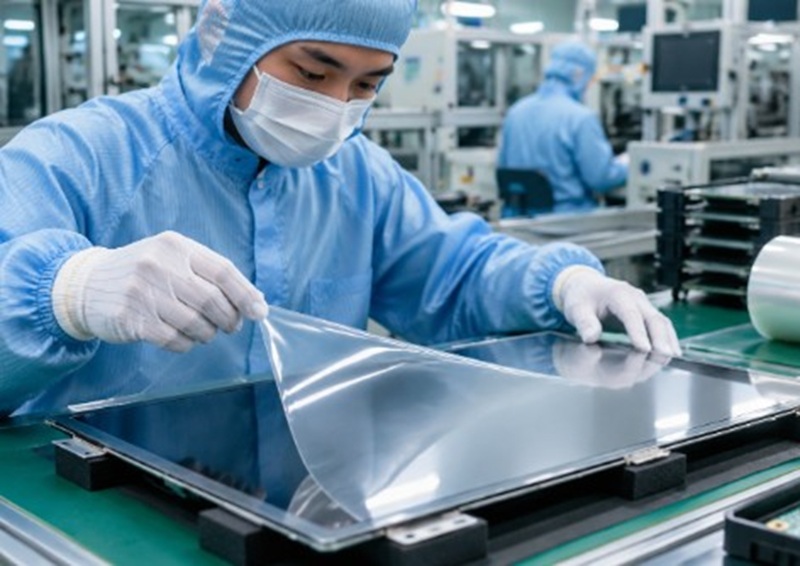
Electronic products can leave a production line looking perfect and still arrive with scratched displays, marked housings, dust contamination or handling damage.
These problems can occur during inspection, assembly, movement between workstations, temporary storage and transportation.
As components become smaller and surface finishes more demanding, protection needs to be built into the workflow.
The right electronic protective film for manufacturing can help preserve exposed surfaces as parts move through these stages. However, surface protection and electrostatic discharge (ESD) control are related but different requirements.
Surface Damage Often Starts Before Final Packaging
Display modules, cover lenses, touch panels, optical sheets and electronic housings may pass through several handling stages before packing. Contact with fixtures, trays, tools or adjacent components can leave scratches and marks. Particles may also become trapped between surfaces during stacking or movement.
Temporary protective film creates a removable barrier during selected processing, inspection, assembly and internal transfer. It can be removed at a defined stage, reducing direct contact with visible or coated surfaces.
The film must match the actual finish. Smooth glass, coated plastic and textured housings may respond differently to the same adhesive. Excessive tack can increase peel force or leave residue; insufficient tack can cause edge lifting, wrinkles or movement on the line.
ESD Control Requires More Than an Anti-Static Label
Static can develop when film is unwound, laminated, rubbed against another material or peeled from a component. Separation deserves particular attention: acceptable surface-resistance results do not automatically mean low charge generation during removal.
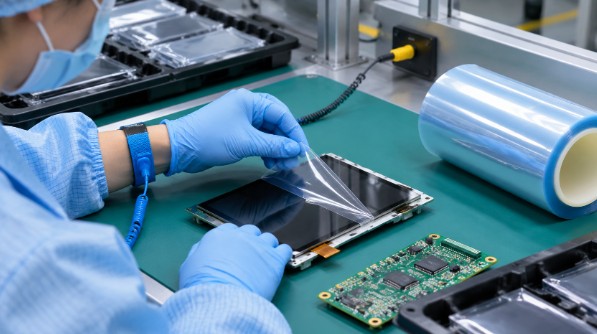
An anti-static protective film for ESD control should therefore be specified by its construction and intended function. Depending on the grade, treatment may be on the exposed film surface, adhesive side or both. Test results should identify the measured side and conditioning conditions. For sensitive applications, resistance should be reviewed alongside peel electrification, removal speed, substrate and dwell time.
A protective film is only one part of a wider ESD programme. IEC 61340-5-1:2024 addresses ESD control across manufacturing, handling, packaging and transport, while ANSI/ESD S541-2026 covers ESD protective packaging materials. Surface film does not replace grounding, personnel controls, an electrostatic protected area or suitable shielding packaging where required.
Match PET or PE to the Part and Process
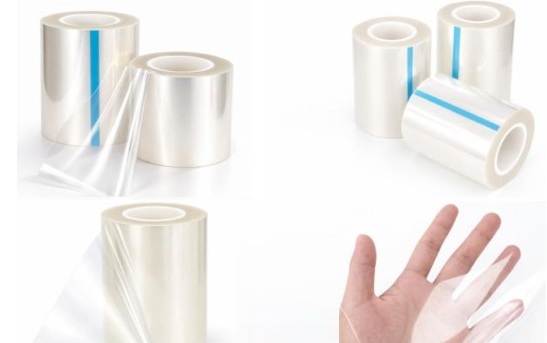
PET is often considered where flatness, dimensional stability, optical inspection and precision converting matter. PE can be preferable when flexibility and conformity to a less uniform surface are priorities.
For finished electronic parts, removable PET protective film for electronics can provide a stable carrier for coated housings, indicator windows, decorative trim and other rigid surfaces. Clear grades also allow visual checks while the film remains applied.
Choose adhesion according to surface finish, application pressure, protection period and removal stage—not simply the lowest tack available. Test production-representative parts and record initial and aged peel behaviour. After removal, inspect for transfer, residue, ghosting, staining, gloss change or coating disturbance. If parts experience heat, cleaning, compression or long storage, reproduce those conditions during validation.
Extend Protection Through Internal Logistics and Shipping
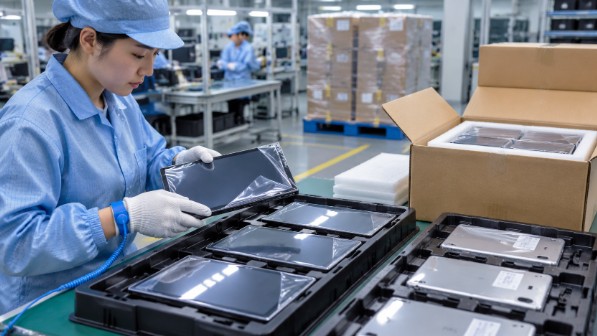
The route from assembly to dispatch may involve trays, carts, temporary racks, warehouse handling and multiple packaging operations. A protective layer can reduce direct contact damage during these movements, helping components reach the next process in acceptable condition.
Surface protection and transport protection solve different problems. Film protects the component surface; trays, cushioning, rigid containers and ESD packaging address other risks such as impact, vibration and electrostatic exposure. Select packaging according to component sensitivity and conditions outside the protected production area.
Define when the film is removed. Removing it too early exposes the surface to later handling, while leaving it on through incompatible bonding, printing, coating or cleaning may affect process performance. A clear removal point avoids uncertainty between production, quality and logistics teams.
Validate the Film on the Actual Production Line
Before volume approval, test the film on the real component and process. A practical evaluation should include:
- The exact substrate, coating, texture and cleaning condition.
- Application method, pressure, line speed and protection period.
- Film-side and adhesive-side resistance, where relevant, plus peel electrification.
- Edge holding, wrinkles, residue and appearance after removal.
- Storage time, temperature, humidity and downstream process exposure.
- Roll width, core size, outside diameter, winding direction and equipment compatibility.
These checks prevent a common mistake: approving a film through a short manual trial and assuming it will behave the same on an automated line or after several days of contact. Approved samples and recorded specifications also make repeat orders easier to compare.
Make Surface Protection Part of Quality Planning
AOBERISFILM provides PET and PE surface protection films for electronics manufacturing, industrial assembly and supply chain applications. Options can be tailored by adhesive behaviour, thickness, roll dimensions, colour and converting format, according to the protected surface and production conditions.
The objective is not to add film to every component. It is to identify where temporary protection can prevent surface damage, where separate ESD controls are required, and how both can be validated before scale-up. Making these decisions early helps manufacturers reduce handling-related defects and maintain consistent product condition from the factory floor to the next destination.
About the Author
Johnnie Au is the Sales Manager at AOBERISFILM, a supplier of PET and PE surface protection films for electronics manufacturing, industrial assembly, and supply chain applications. He focuses on helping customers identify suitable protective film materials, adhesive properties, and converting specifications for protecting electronic surfaces during production, storage, and transportation.
 SAP Empowers Developers to Drive the Business AI Revolution
 Tech experts discuss the three-year anniversary of GDPR
 Post acquisition, Pole Star Global continues to expand its North American presence with key hires
 50,000 postal roll containers always in view
 Doosan highlights performance at LAMMA 20
 Take Control of the Situation: MPO’s Emergency Relief Cloud Solution