

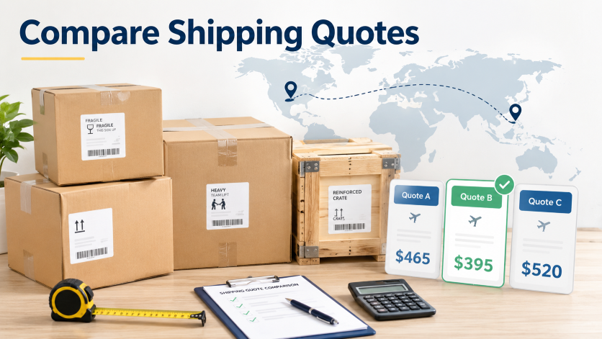
When you send household items, school belongings, business samples, small inventory, collectibles, or oversized packages to another country, it makes sense to ask several companies for quotes.
One company may offer a low number, while another asks nearly twice as much for what seems to be the same shipment.
The cheapest quote can be tempting, but it may not include the same route, service level, or cargo measurements.
A fair comparison starts with one rule: every company must quote the same shipment under the same conditions.
A Low Quote May Cover Less Than You Think
One quote may include only airport-to-airport or port-to-port transportation. Another may include pickup, document handling, customs support, and final delivery.
A low price may also be based on estimated dimensions. Once the boxes are collected and measured again, the total can change if the shipment is larger or heavier than expected.
When one quote is far below the others, ask where the shipment starts, where it ends, and which services are included between those points.
Start With the Exact Route and Shipping Method
International shipping prices depend first on the origin and destination. The same boxes can cost very different amounts depending on the countries, cities, ports, airports, and transfer points involved.
The shipping method must also match. Express delivery, air freight, and ocean freight use different pricing systems and offer different transit times. A slow ocean quote should not be compared directly with a fast courier quote.
For a route-specific example, Gorto Freight’s Philippines-to-USA shipping services outline ocean, air, and express options, along with estimated transit times and the main pricing factors.
This does not mean every provider accepts every type of personal shipment. Household goods, batteries, and food may have separate requirements. Confirm that each company will accept the contents and quote the same route and shipping method.
Give Every Company the Same Shipment Details
A quote is only as accurate as the information used to create it.
Saying “I have ten large boxes” is not enough. One person’s large box may be twice the size of another’s. Ten regular cartons also use much less space than ten wooden crates on pallets.
Use the same information for every quote. Provide the pickup city, destination city, number of boxes, outside dimensions of each box, weight of each box, and total weight.
If the boxes are not fully packed, say that the measurements are estimates. Do not reduce the dimensions or weight to get a lower quote. The shipment will usually be measured again, and the price may be adjusted.
Check What Pickup, Customs, and Delivery Include
“Shipping from one country to another” does not describe the full service.
Some quotes begin after you deliver the boxes to a warehouse. Others include pickup from your home. A company may handle only international transport, leaving the receiver to arrange customs clearance and local delivery.
Final delivery can mean a business address, a home, the curb, a warehouse, or a pickup terminal. Remote areas, apartments, limited-access locations, and homes without unloading equipment may cost more.
Ask the company to explain the start and end points. Confirm whether pickup, export documents, customs clearance, duties and taxes, storage, and final delivery are included.
Terms such as “door to door” are not enough by themselves. You need to know whether the boxes will be left at the curb, delivered to the building entrance, or carried farther inside.
Measure the Boxes After Packing
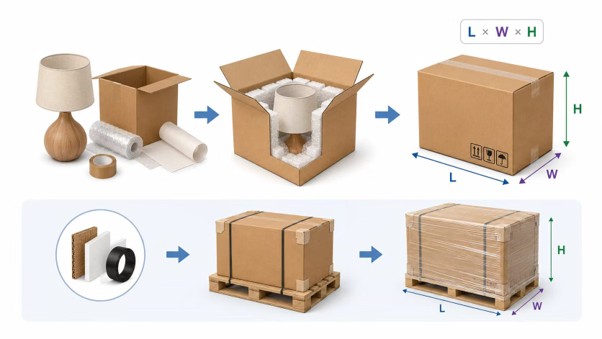
Shipping companies care about both the space and weight of your fully packed boxes, not the size of the items before wrapping.
Padding, wooden frames, pallets, and outside supports all add to the final dimensions. A small object can require a much larger box once it is protected.
Measure the longest outside length, width, and height of every packed box. Include bulges, handles, straps, or parts that extend beyond the carton. Use the packed gross weight, not the product’s net weight.
Large but lightweight items can still cost more than expected. Pillows and blankets may take up a great deal of cargo space even when they do not weigh much.
Calculate the Total Space Your Boxes Use
For LCL ocean freight, total volume is a major part of the quote.
Learning how to calculate CBM helps you estimate the cubic-meter space used by your packed boxes. Convert the length, width, and height of each box into meters, multiply those numbers, and add the volume of all boxes together.
Include pallets, crates, and outside packaging. If a carton expands after it is filled, measure the widest points rather than the printed size on the box.
CBM does not produce the final shipping price by itself. The route, shipping method, total weight, cargo type, and delivery service still matter. However, accurate volume information makes the first quote more useful and reduces the chance of a major price change after pickup.
Understand Why the Price Can Change After Pickup
Even a detailed quote may change if the actual shipment does not match the original information.
A warehouse may record a higher weight or larger dimensions. The sender may add boxes at the last minute. Loose cartons may need to be placed on a pallet, increasing the shipment’s total size.
Delivery conditions can change the price too. A quote based on a commercial address may rise if the final destination becomes a home, a remote area, or a location that needs an appointment or smaller truck.
Some costs appear only in certain situations, such as inspections, storage, waiting time, or a second delivery attempt. Ask which charges are fixed and which depend on what happens.
A quote can be an estimate, but the reasons for later adjustments should be clear.
Compare the Final Total, Not the Base Rate
Put every quote into the same service range before comparing the numbers.
A low base rate may become expensive if it excludes pickup, customs clearance, destination handling, or final delivery. A higher quote may offer better value because more of the journey is included.
Transit time also matters. A slower service may save money, but it may not work if the boxes must arrive before a school term, move-in date, or family event.
Compare insurance rules, tracking, payment terms, and who handles problems. The cheapest quote is not automatically risky, but the company should be able to explain why its price is lower.
Conclusion
The best way to avoid overpaying for international box shipping is not to chase the lowest number. It is to make every quote accurate and comparable.
Confirm that each company is quoting the same route and shipping method. Provide identical box dimensions, weights, and cargo details. Check whether pickup, customs, and final delivery are included, and ask when the price may change after measurement.
Once every quote is built on the same facts, it becomes much easier to see which offer is truly better and which low price simply leaves important costs for later.
 Exploring the Exciting Innovations & Predictions for the Future of Online Blackjack in 2023
 Brexit has already cost more than the International Space Station – & it’s still rocketing!
 The Impact of AI and Automation on Modern Financial Trading
 Linnworks showcases latest innovative marketplace partnerships & product enhancements
 Four key steps for a strategic supply chain
 Loftware Hosts Largest Labeling & Artwork Management Conference of the Year