

The year 2026 marks a definitive turning point for global supply chains. The traditional, multi-node procurement models are no longer sufficient for the demands of modern commerce.
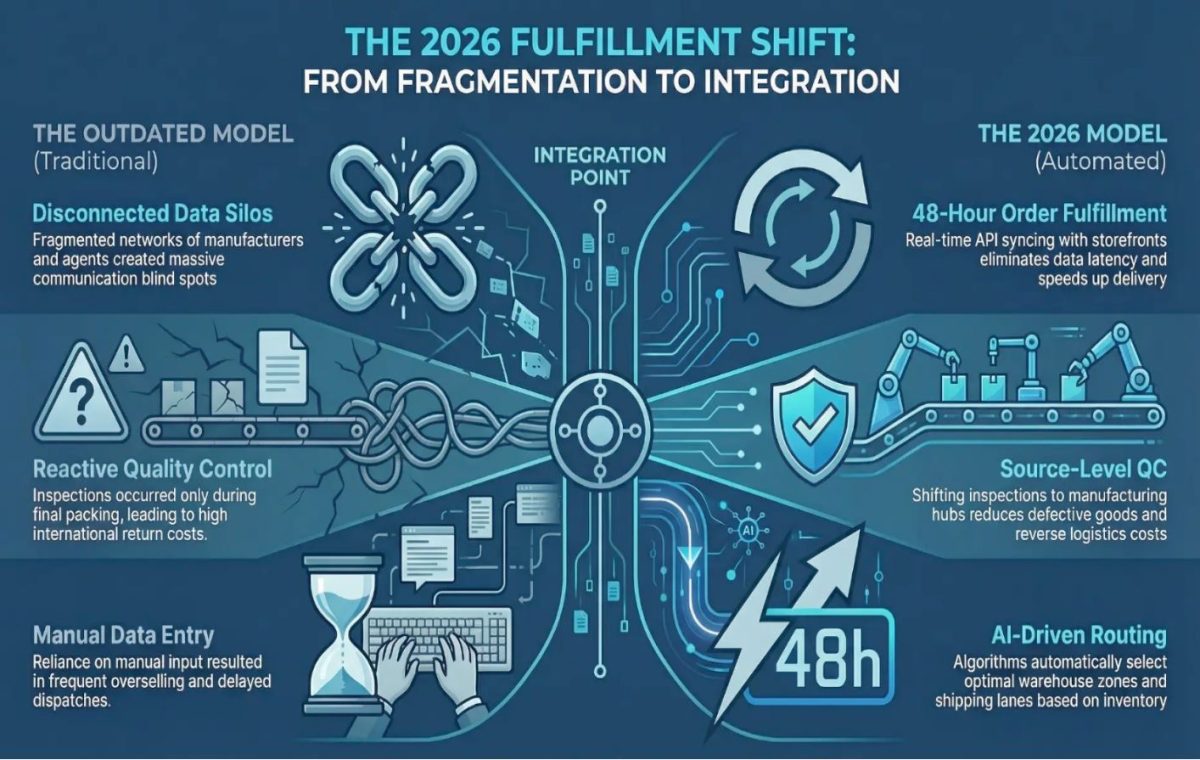
Historically, retailers relied on a highly fragmented network of manufacturers, forwarding agents, and regional distribution centers. This disconnected approach created massive data silos and costly delays.
Today, agile e-commerce logistics has completely disrupted that outdated model. Supply chain leaders are replacing these disjointed systems with end-to-end fulfillment solutions that offer unparalleled visibility.
- Centralized Data: Eliminates the blind spots between manufacturing hubs and final mile delivery.
- Reduced Touchpoints: Streamlines the journey from factory floor directly to the consumer’s doorstep.
- Real-Time Analytics: Allows logistics directors to predict bottlenecks before they cascade through the network.
Overcoming Cross-Border Bottlenecks with API Integrations
Cross-border shipping has historically been plagued by severe communication bottlenecks. When inventory data fails to match frontend storefronts, the result is overselling, delayed dispatch, and frustrated customers.
To remain competitive and avoid stockouts, modern e-commerce operations are abandoning fragmented logistics in favor of fully integrated fulfillment models.
For instance, forward-thinking platforms now leverage Speedbee that syncs directly with storefronts like Shopify in real-time. This effectively enables 48-hour order fulfillment and eliminates the traditional data latency that plagues decentralized supply chains.
The implementation of robust API integrations transforms the Warehouse Management System (WMS) into a dynamic, intelligent hub.
- Instant Order Syncing: Removes manual data entry, reducing human error rates to near zero.
- Automated Routing: Assigns orders to the optimal warehouse zone instantly based on real-time inventory levels.
- Dynamic Carrier Selection: Algorithms automatically choose the fastest and most cost-effective shipping lanes.
Quality Control (QC) as a Core Supply Chain Metric
The traditional industry mindset often relegated Quality Control (QC) to a simple checklist during the final packing phase. In 2026, this reactive approach is recognized as a major drain on profitability and operational efficiency.
Forward-thinking supply chain architects now treat QC as a highly integrated, preventative supply chain metric.
By shifting quality inspections directly to the source—such as centralized manufacturing hubs in China—companies drastically reduce the volume of defective goods entering the logistics network.
This shift to source-level QC creates a powerful ripple effect across the entire fulfillment lifecycle.
- Reduced Reverse Logistics: Minimizes the astronomical costs associated with processing international returns.
- Optimized Freight Spend: Ensures that shipping budgets are only utilized for viable, sellable products.
- Enhanced Brand Trust: Dramatically lowers dispute rates and chargebacks on the consumer front.
Navigating Geopolitical and Shipping Risks in 2026
The current decade has proven that relying on a friction-free global shipping environment is an unsustainable business model. Escalating geopolitical tensions and unpredictable cargo capacity continue to challenge operations.
Global supply chain disruptions continue to pose significant threats to retail margins.
In fact, building supply chain resilience and risk management has shifted from a theoretical strategy to an operational necessity. Companies without end-to-end visibility are significantly more likely to experience critical disruptions during peak seasonal demands.
To buffer against these macro-environmental shocks, logistics leaders are heavily investing in strategic centralized warehousing.
- Proximity to Transit Hubs: Placing facilities near major international airports ensures immediate access to primary airfreight arteries.
- Dynamic Rerouting: Utilizing AI-driven logistics software to pivot carrier networks instantly when a primary route is compromised.
- Buffer Stock Optimization: Using predictive analytics to maintain precise safety stock levels without inflating holding costs.
Key Takeaways
| Area | Key Takeaway | Impact/Data |
| Tech Sync | Automate order routing via direct API integrations | Enables 48-hour fulfillment; cuts errors to near zero |
| Source QC | Relocate quality inspections directly to manufacturing hubs | Eliminates reverse logistics costs; stops defective shipping |
| Risk Mgt | Centralize warehousing near transit hubs with AI rerouting | Protects margins against geopolitical shocks |
Conclusion: The Future of Tech-Driven Fulfillment
The landscape of global retail has permanently shifted away from manual, segmented logistics processes. In 2026, the success of a cross-border e-commerce operation is entirely dependent on its technological infrastructure.
From API-driven inventory synchronization to proactive risk management, automation is the undeniable bedrock of modern supply chains.
To survive and thrive, logistics directors and supply chain managers must fully embrace these integrated frameworks.
Ultimately, technology-driven fulfillment is not just a competitive advantage; it is the absolute baseline for operational survival.
 Remote WMS Implementation facilitates timely expansion for Watch Gang
 A Purpose-Driven Supply Chain Requires Redefining Key Performance Indicators
 With shop price inflation the highest in a decade, continued focus on empathy as part of the customer experience is vital
 Dematic launches Auto Bagging Solution for faster ecommerce
 Gioseppo strengthens its logistics operations with the new version of Easy WMS
 Getac Unveils World’s First Rugged Copilot+ PC