

An AMR quote usually prices the robots. A working system also needs simulation, infrastructure, IT integration, safety verification, training and support.
A business case that counts only the vehicles often fails at the first budget review. The fix is simple: cost the whole system before you compare suppliers.
The robot is one line in a longer list
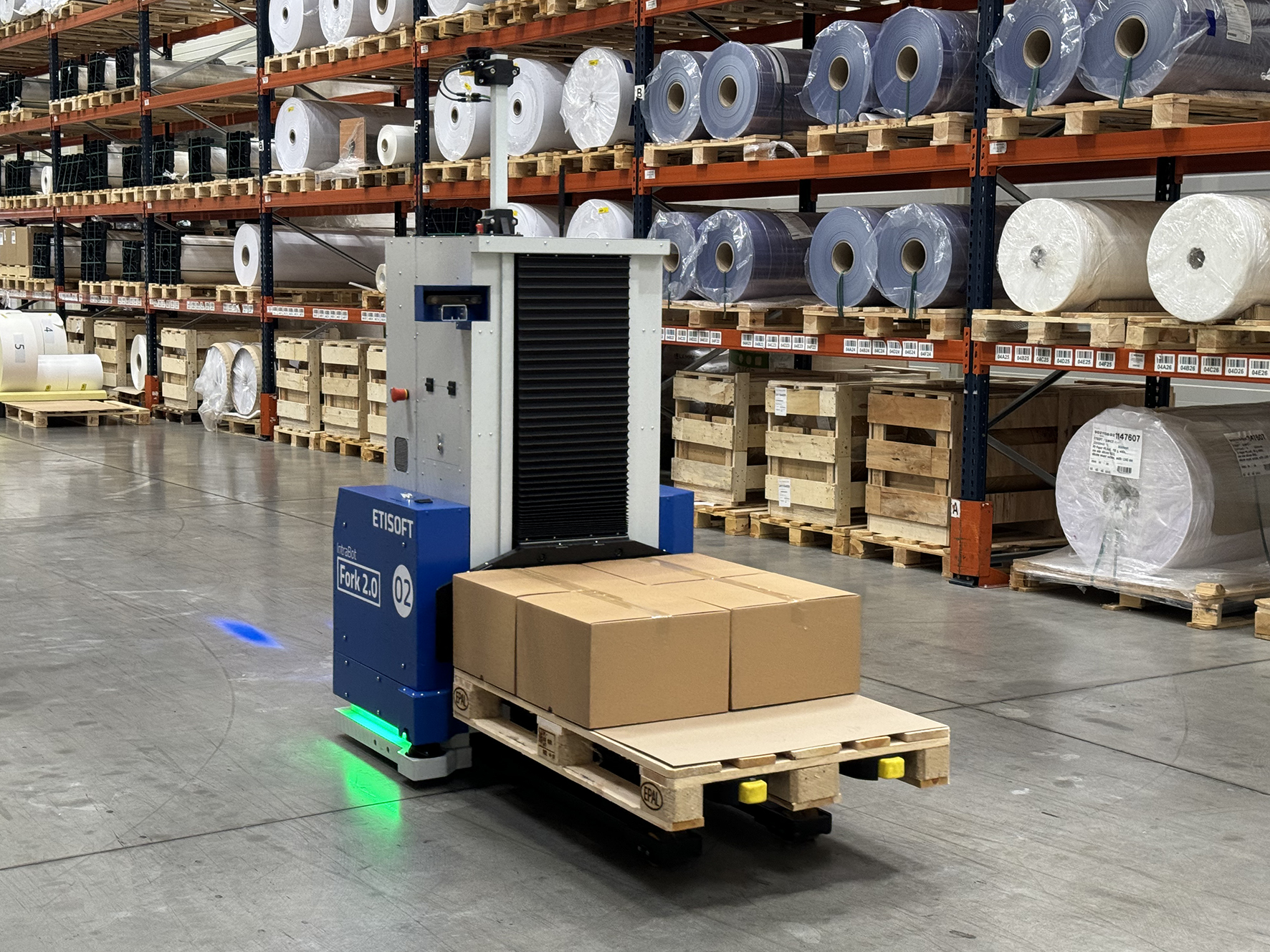
The vehicle fleet is usually a minority of the scope in an AMR project. One published example shows this clearly. In late 2019 and early 2020, the intralogistics team of Etisoft delivered a system for the Lumileds Poland plant in Pabianice. The published scope had nine elements:
-
- design and simulation of the complete system
- a fleet of 6 AMR/AGV vehicles with automatic charging stations
- fleet management software with mission management, reporting and a machine book
- integration of that software with the customer’s infrastructure
- buffer roller conveyors, sensors and IT interfaces
- an external safety audit
- operator training
- ICT support during and after implementation
- final acceptance according to a FAT specification
Only item 2 is the robots. A comparison of supplier quotes that looks at item 2 alone compares the wrong thing.
Cost 1: analysis and simulation before the contract
Simulation is the cheapest place to find out that the planned fleet is too small. In the Pabianice project, engineers started from a 3D scan of the production hall. They then built a numerical model in FlexSim that included external process disturbances.
The model showed that 6 vehicles, working 24/5, could handle production peaks of up to 30 pallets per hour. Performance tests four months after project approval verified this result. Without that step, the fleet size is a guess, and the business case is a guess too.
Cost 2: infrastructure around the robot
AMRs need fixed points to pick up and deliver loads. Those points cost money and floor space. The Pabianice layout used 38 logistics points on a 250-metre loop, with buffer roller conveyors and sensors.
A smaller project shows the same pattern. At Etisoft’s own label production plant, one pallet robot needed 6 storage docks. The team also installed light signals on the docks, andon status devices and a board that shows the robot’s location. None of this is the robot, but the system does not work without it.
Cost 3: integration with production systems
The value of an AMR comes from missions that start automatically. That requires integration with the MES or WMS, and integration takes hours on the customer’s IT side as well as the supplier’s.
At the Etisoft label plant, a machine operator triggers a transport request on a panel. The fleet software, integrated with the MES, then generates a mission to the correct destination point. After delivery, the robot brings an empty pallet back to the station. Budget the internal IT work for this interface explicitly. It is rarely in the supplier’s price.
Cost 4: safety verification, and what it does to throughput
Safety rules change the capacity figures in the business case. ISO 3691-4:2023 sets safety requirements, and the means to verify them, for driverless industrial trucks, including AGVs and AMRs. Budget for the risk assessment, the audit and the commissioning checks. Some suppliers of automated pallet transport systems include a preliminary safety audit in the design stage.
Speed limits are the less obvious cost. The robot at the Etisoft label plant can reach 5 km/h. In the hall, it moves at up to 2 km/h. It slows to 1 km/h when people or objects enter its warning zone. It stops when the protection zone is violated.
A business case built on the robot’s maximum speed will overstate throughput. Calculate cycle times with the speeds that the safety concept allows. If the result is too slow, the answer may be more vehicles, and that belongs in the budget now.
Cost 5: people, training and support
The organisation has to change around the robots. At the Etisoft label plant, the project team named three success factors: employee discipline, openness to innovation and management commitment.
These factors have a cost. Operators need training. Someone must own the system after go-live. Support must cover the working pattern: the Pabianice system runs 24/5 with telephone support. Ask every supplier what their support covers and at what hours.
A business case that survives review
A complete AMR business case asks the same questions of every supplier:
| Cost item | Question for the supplier |
|---|---|
| Analysis and simulation | Do you simulate the process with disturbances before the contract? |
| Infrastructure | Which docks, conveyors, sensors and charging stations are included? |
| IT integration | Which interface to our MES or WMS do you provide, and what work stays with our IT team? |
| Safety | Who performs the risk assessment and the audit? What speeds does the safety concept allow? |
| Training and support | How many people do you train? What support hours do you provide after go-live? |
| Acceptance | What are the acceptance criteria, and are they written into a FAT specification? |
The savings side needs the same discipline. In Pabianice, the published return on investment was shorter than 3 years. It came from replacing forklift trucks, lower labour costs and continuous operation during employee absence, at night and at weekends. Before the project, 9 employees with hand pallet trucks carried out the internal transport.
A business case that lists all costs and all savings is harder to write. It is also the only version that survives the first review.
 Twitter verification phishing
 Bridgestone’s ‘Inspirational’ Headquarters officially reopened by gold-medal ambassadors
 Barilla Achieves 80% Visibility into Ocean and Over-the-Road Shipments with FourKites
 Going the last mile: How to overcome the sustainability challenge
 Softeon Reveals Updated Brand to Showcase Ability to Help Manage Increasing Warehouse Complexity
 Increased throughput for occupational safety: Körber helps AS Arbeitsschutz increase throughput by 50 percent