

Why Search Visibility Looks Completely Different in 2026
There was a time when ranking on Google felt like the finish line.
If your content reached the first page, traffic followed. If you built enough backlinks, optimized a few pages, and stayed consistent, growth usually came naturally after that.
That is no longer how search works.
Over the past two years, businesses across almost every industry have noticed the same thing happening at the same time. Impressions continue rising, yet clicks are falling. Pages that once brought steady traffic now barely convert. Even companies that invested heavily in SEO suddenly feel invisible online.
A large part of the shift comes from how people search today. Google AI Overviews answer questions before users ever visit a website. ChatGPT, Gemini, and Perplexity summarize information directly inside conversations. Search is no longer limited to ten blue links.
This is why many marketing teams are starting to rethink what visibility actually means.
It is no longer just about rankings.
It is about whether your brand appears inside AI generated answers, whether your business is being cited accurately, and whether potential customers even discover you before a competitor gets mentioned first.
According to recent industry projections, traditional search volume may decline by 25% by 2026, while AI driven search behavior continues to accelerate. At the same time, AI search visitors are converting at much higher rates than traditional organic traffic because users often arrive with stronger intent.
That change is creating a new category of tools focused not only on SEO, but also on AI visibility.
And this is exactly where Semrush One Solution has started standing out.
Instead of treating AI search as a separate experiment, the platform combines traditional SEO workflows with AI visibility tracking in one place. For companies trying to understand why traffic patterns are shifting or why competitors suddenly dominate AI generated answers, that combination feels especially relevant right now.
Before diving into the tools themselves, it helps to look at how the market is evolving and why businesses are starting to compare SEO platforms very differently than they did even a year ago.
The SEO Platforms Businesses Are Actually Comparing in 2026
The SEO software market has become crowded over the years, but the comparison buyers make today is no longer just about keyword tracking or backlink databases.
Teams now want to know:
- Can this platform help us appear in AI generated answers?
- Can we monitor how our brand is represented inside AI search?
- Can we combine traditional rankings and AI visibility without juggling five separate tools?
- Can we spot traffic loss before it becomes a larger problem?
That is why the conversation around SEO software has shifted toward complete search visibility platforms rather than standalone optimization tools.
The interesting part is that most companies are no longer choosing a tool purely because of keyword databases or reporting dashboards.
They are choosing based on adaptability.
Search behavior is changing too quickly for platforms that only solve yesterday’s SEO problems.
Semrush One: Best for Brands Trying to Win Both SEO and AI Search
The reason Semrush One has gained attention recently is because it approaches search visibility from a broader perspective.
Instead of positioning itself as only an SEO toolkit, it focuses on helping brands understand how they appear across both traditional search engines and AI generated search experiences.
That distinction matters more than it sounds.
A company may still rank well on Google while losing visibility inside AI generated responses. Another business may appear in ChatGPT answers but not understand why competitors are cited more often. Without visibility into those patterns, marketing teams are left guessing.
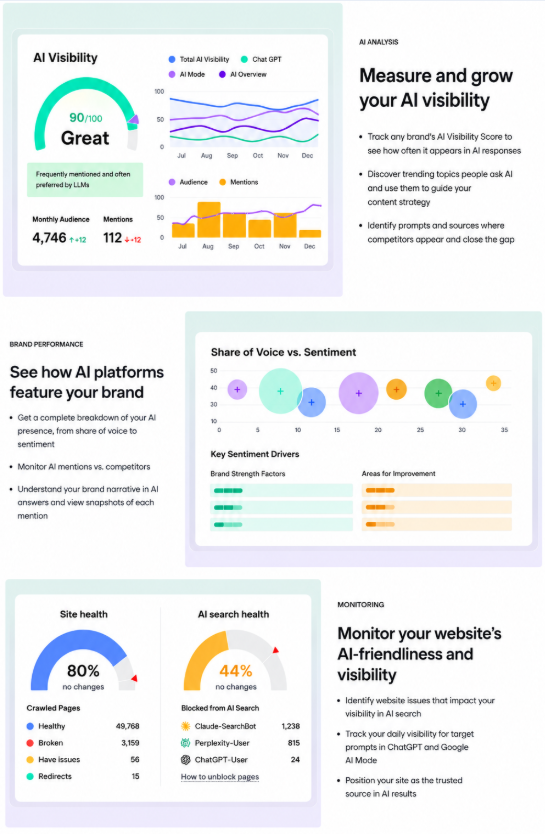
The platform combines traditional SEO workflows with its AI Visibility Toolkit so businesses can monitor:
- Visibility scores across AI platforms
- Prompt mentions and share of voice
- Competitor citations
- Brand sentiment in AI generated answers
- Technical readiness for AI discovery
- Traditional keyword rankings and backlinks
One of the more practical features is how the platform tracks multiple AI ecosystems together instead of isolating one channel.
Rather than only focusing on ChatGPT, the system monitors visibility across Google AI Overviews, Gemini, Perplexity, and other AI driven environments where customers increasingly discover products and services.
That broader view feels especially useful for companies trying to understand unexplained traffic declines.
A lot of businesses are seeing the same pattern right now. Their rankings may still look acceptable in Google Search Console, yet traffic and conversions continue slipping. In many cases, users are simply getting answers directly from AI generated summaries instead of clicking through to websites.
This is where Semrush One starts feeling less like a traditional SEO platform and more like a search visibility command center.
The AI Visibility Toolkit is arguably the biggest reason for that shift.
The dashboard focuses heavily on share of voice, citation tracking, and AI presence rather than just rankings. It gives businesses a clearer picture of whether they are part of the conversation happening inside AI generated results.
Internally, Semrush reportedly increased its own share of voice from 13% to 32% within one month using the platform’s visibility tracking workflows.
For many marketing teams, that kind of measurable insight is more actionable than simply knowing where a keyword ranks.
The scale of the platform is also difficult to ignore.
The ecosystem currently includes:
- 27.5 billion keywords globally
- 3.7 billion U.S. keywords
- 43 trillion backlinks
- 808 million tracked domains
- Historical data reaching back to 2012
- More than 239 million AI prompts tracked
Those numbers matter because search visibility increasingly depends on context, patterns, and competitor movement across multiple channels.
The biggest limitation is probably the learning curve.
Because the platform combines multiple workflows together, newer marketers may initially feel overwhelmed by the number of features available. Smaller creators who only need lightweight keyword research may also find the pricing difficult to justify.
But for companies managing content, paid search, technical SEO, competitor research, and AI visibility simultaneously, the consolidation can actually reduce complexity instead of adding to it.
That is the real appeal.
Ahrefs: Still One of the Strongest Platforms for Backlink Research
Even with the rise of AI visibility tools, Ahrefs continues to hold a strong reputation among SEO professionals, particularly for backlink analysis and competitive research.
The platform built its identity around crawling the web aggressively and surfacing link data quickly, and that strength still matters today.
For agencies and technical SEO specialists, Ahrefs often feels fast, focused, and highly reliable when it comes to analyzing domains, content performance, and competitor gaps.
Its Site Explorer remains one of the most widely used features in the industry because it simplifies large scale backlink evaluation without becoming overly cluttered.
Another advantage is geographic coverage.
Many users working across international markets appreciate how broad the keyword tracking system has become over time. The platform also maintains a strong reputation for content gap analysis and identifying ranking opportunities efficiently.
That said, the biggest conversation around Ahrefs right now is not about backlinks.
It is about AI visibility.
While the company has introduced AI focused capabilities like Brand Radar, those features still feel more like additions rather than a deeply integrated visibility workflow.
For businesses trying to understand how they appear across AI generated search environments, the experience is not yet as unified as what platforms like Semrush One are attempting to build.
That does not make Ahrefs weak.
It simply means the platform still feels primarily centered around traditional SEO operations.
Here is how the two platforms compare across several key areas.
| Metric | Semrush | Ahrefs |
| AI Visibility Tracking | Included | Add on features |
| Backlinks | 43 trillion | 35 trillion |
| U.S. Keywords | 3.7 billion | 2 billion |
| PPC Research | Yes | No |
| Historical Data | Since 2012 | Since 2015 |
| AI Prompt Tracking | Integrated | Limited |
Ahrefs may still appeal more to technical SEO specialists who prioritize backlink analysis and streamlined research workflows.
However, companies trying to manage both AI search visibility and traditional SEO together may find themselves wanting a more unified platform experience.
That is where the positioning difference becomes noticeable.
Moz Pro: Easier for Beginners but Less Equipped for AI Search
Moz has always occupied an interesting place in the SEO industry.
For many marketers, it was the first platform that made SEO feel approachable instead of intimidating.
The interface tends to feel simpler, the reporting is easier to understand, and the overall learning curve is less aggressive compared to enterprise level platforms.
That accessibility still gives Moz an advantage for beginners, smaller businesses, and teams that do not need highly advanced workflows.
Local SEO is another area where the platform continues performing well.
Businesses focused on regional visibility often appreciate the cleaner reporting structure and easier onboarding experience.
But the limitations become more visible when teams start scaling.
Compared to larger platforms, the underlying data ecosystem is much smaller. The keyword database and backlink index simply do not operate at the same scale.
More importantly, AI visibility has not become a major integrated component of the platform yet.
That gap matters because many businesses are no longer evaluating tools based only on rankings.
They want to understand whether AI generated answers are surfacing their brand correctly, whether competitors dominate conversational search, and how customer discovery behavior is shifting.
Moz still works well for learning SEO fundamentals and managing simpler campaigns.
But companies trying to prepare for the future of search may eventually outgrow it.
This is one reason Semrush One continues gaining traction among larger marketing teams.
The platform’s combination of SEO research, competitor analysis, AI visibility monitoring, and technical auditing creates a more centralized workflow for businesses managing multiple growth channels at once.
That broader functionality may not matter to every company.
But for organizations experiencing traffic volatility, attribution confusion, or visibility decline inside AI search environments, having those systems connected together becomes increasingly valuable.
SE Ranking and Ubersuggest: Budget Friendly but Limited at Scale
Not every company needs enterprise level SEO software.
For freelancers, solo creators, or startups managing smaller websites, lower cost platforms like SE Ranking and Ubersuggest still offer reasonable value.
Both tools focus heavily on accessibility.
They simplify keyword tracking, provide basic competitor insights, and help smaller teams organize SEO tasks without overwhelming dashboards or expensive contracts.
That simplicity is exactly why many users start there.
The issue usually appears later.
As businesses grow, reporting needs become more advanced. Teams begin asking harder questions about traffic attribution, SERP volatility, AI search visibility, and competitive positioning.
Budget platforms often struggle to keep pace with those demands.
The databases are typically smaller, the backlink tracking less comprehensive, and the AI visibility capabilities still fairly limited.
For example, a growing ecommerce company may eventually want:
- Daily visibility monitoring across AI platforms
- Citation tracking inside AI generated answers
- Historical search behavior analysis
- Technical audits for AI discoverability
- Large scale competitor benchmarking
That is where lighter platforms start showing their limits.
This does not mean budget tools are bad.
They simply solve a different problem.
A freelancer running a few websites may prioritize affordability and ease of use. A larger brand managing multiple stakeholders usually prioritizes visibility depth, integrations, and forecasting.
That distinction explains why platforms like Semrush One are increasingly positioned toward businesses treating search visibility as a long term growth system rather than a collection of isolated SEO tasks.
Why AI Visibility Is Becoming the Most Important SEO Conversation
One of the biggest mistakes companies make right now is assuming AI search will behave exactly like traditional search.
It will not.
When users interact with ChatGPT, Gemini, or AI Overviews, they often receive summarized answers immediately. Those summaries shape brand perception before a user even reaches a website.
That changes everything.
Businesses are no longer competing only for rankings.
They are competing for mentions, citations, sentiment, and inclusion inside AI generated conversations.
And unlike traditional SEO, many companies still have almost no visibility into how they appear inside those systems.
This is why AI visibility platforms are becoming increasingly important.
Marketing teams need to know:
- Which prompts surface their brand
- Which competitors are cited more frequently
- Whether AI platforms describe their products accurately
- How their share of voice changes over time
- Which content formats influence AI citations
Without that visibility, optimization becomes reactive.
You notice traffic declines after they happen instead of understanding why they happened.
This is also why the broader positioning behind Semrush One feels timely.
The platform does not frame AI search as a replacement for SEO.
Instead, it treats AI visibility as an expansion of search behavior itself.
That mindset probably reflects where the industry is heading.
Traditional rankings still matter.
Backlinks still matter.
Technical SEO still matters.
But now businesses also need systems that help them understand conversational search ecosystems where clicks are no longer guaranteed.
The companies adapting fastest are not abandoning SEO.
They are expanding how they define visibility.
So Which Platform Actually Makes the Most Sense?
The honest answer depends less on popularity and more on what kind of business you are running.
If your priority is lightweight SEO management at the lowest possible cost, simpler tools may work perfectly fine.
If your workflow revolves around backlink research and technical SEO analysis, Ahrefs still remains one of the strongest platforms available.
If you are learning SEO for the first time and want a gentler learning curve, Moz can still be a comfortable starting point.
But for businesses trying to understand both traditional search visibility and AI generated discovery together, the market is shifting toward platforms that combine those workflows instead of separating them.
That is ultimately where Semrush One stands out.
The platform acknowledges something many businesses are already feeling:
Search behavior has changed faster than most marketing systems.
Traffic patterns no longer make sense through traditional SEO metrics alone.
AI generated answers influence purchasing decisions before users ever visit websites.
And brands need better visibility into that ecosystem if they want to stay competitive over the next few years.
No platform solves every problem perfectly.
Even the strongest tools come with learning curves, pricing considerations, and feature trade offs.
But the platforms likely to matter most moving forward are the ones helping businesses adapt to where search is going rather than where it used to be.
That is why AI visibility is becoming such a critical conversation across the industry.
The future of search is not purely traditional SEO.
And it is not purely AI either.
It is the intersection of both.
Most SEO tools today still focus heavily on rankings, keywords, and backlinks.
Those things remain important, but they are no longer enough on their own.
Businesses now need to understand how customers discover information inside AI generated search environments where visibility works differently than traditional search engines.
That shift is exactly why platforms combining SEO and AI visibility are attracting so much attention.
Among the major platforms available right now, Semrush One feels particularly aligned with where search behavior is heading.
Instead of forcing businesses to manage separate systems for SEO and AI discovery, it brings those workflows together in a way that feels practical for modern marketing teams.
The combination of keyword research, backlink analysis, competitor monitoring, AI prompt tracking, visibility scoring, and sentiment analysis creates a broader picture of how brands appear online today.
And for companies struggling with declining clicks, unpredictable traffic patterns, or disappearing visibility inside AI generated answers, that broader picture may become increasingly valuable over time.
Search is not disappearing.
It is evolving.
The brands adapting early will likely have a significant advantage over the next few years because they are optimizing for how people actually discover information now, not how they searched five years ago.
If your business is trying to understand both SEO performance and AI visibility in one place, Semrush One Solution is worth exploring while the industry is still figuring out the new rules of search.
Start with the plan that fits your current workflow, monitor how your brand appears across AI platforms, and build a visibility strategy designed for where search is heading next rather than where it used to be.
**This post is sponsored by Semrush. When you purchase through links in this article, we may earn an affiliate commission from Semrush.**
 August’s sales results show shoppers are still suffering from the KamiKwasi budget a year on
 TruTac catch the compliance bus for 2022 Expo
 Lectra helps automotive suppliers leverage Industry 4.0 opportunity
 Unlocking the Power of SEO with Our Melbourne Agency’s Team of Experts
 Boohoo results highlight need for brand loyalty in the long run
 Understanding the Basics of Margin Analysis: A Beginner’s Guide