

B2B discovery is shifting from blue links to generated answers. If buyers ask ChatGPT, Perplexity, Claude, Gemini or Google AI Overviews for vendor shortlists, you want your brand cited accurately.
I wrote this for SaaS marketing leaders, SEO directors and growth operators choosing an agency partner. I focused on citation tracking, answer formatting, prompt-led strategy, reporting quality and fit for long B2B buying journeys.
Key Takeaways
- Minuttia is my top pick for B2B SaaS teams. It combines SaaS content strategy, LLM citation work, content engineering and prompt-led planning.
- Directive Consulting suits enterprise B2B teams. It connects GEO, AEO, category strategy and off-domain authority.
- FullFunnel fits visibility programs that need GTM alignment. Its model blends expert content, distribution and sales motion support.
- Team4 and Obility B2B are focused B2B options. Both speak directly to LLMs and Google AI Overviews.
- Veza Digital stands out for structured data depth. Growth Anchors is useful when published tiered pricing matters.
- Most agencies price custom. Ask for citation monitoring, AI referral tracking, brand mention reporting and competitive benchmarks before signing.
How I tested
LLM coverage. I prioritized agencies that discuss visibility across ChatGPT, Perplexity, Gemini, Claude and AI Overviews. I also looked for citation tracking rather than broad AI visibility claims.
AEO and structured data. Strong providers connect GEO with answer-engine optimization, schema and extractable content formats. FAQPage, Product, Organization, Person, HowTo and Breadcrumb markup can all help AI systems parse pages.
Prompt-led strategy. I looked for agencies that map buyer prompts, category entities and comparison questions. The stronger fits think beyond keywords and build assets that AI systems can quote cleanly.
B2B fit. SaaS teams need comparison pages, use-case pages, demo paths, reviews, forums and third-party proof. I also weighed citation share, AI referrals, entity accuracy, brand mention monitoring and competitive reporting. For broader context on how enterprise technology decisions are evaluated across the buyer journey, this enterprise technology resource is a useful reference.
What is Generative Engine Optimization?
Generative engine optimization improves how often a brand appears in AI-generated answers. The goal is not only a ranked link, it is being named, summarized and cited inside the answer.
AEO focuses on answer-format responses while GEO is broader across generative surfaces. For B2B teams, measurement shifts toward citations, share of voice, entity accuracy and assisted demand from AI search journeys.
Minuttia
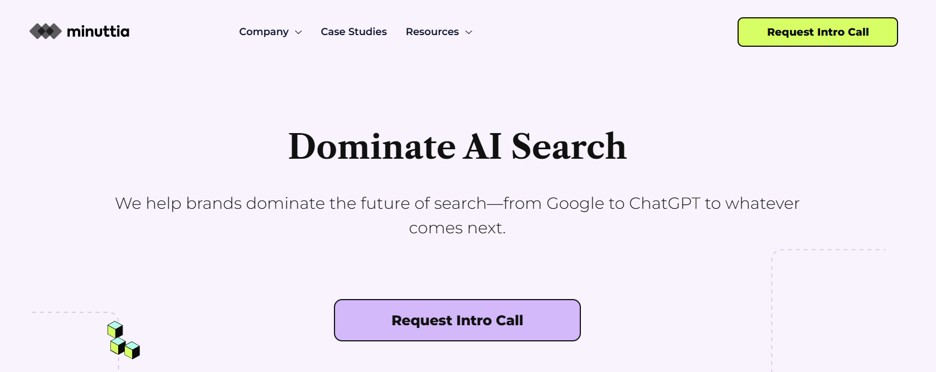
Minuttia is best for B2B SaaS teams that need AI search strategy, content execution and clearer citation paths in one program. The agency works at the intersection of search, content engineering and prompt-led planning, which fits how SaaS buyers move through long evaluation cycles.
Minuttia pros
- B2B SaaS focus that fits long buying journeys
- Strategy for Google and AI search, not just keyword rankings
- Content-engineering mindset for extraction, summaries and citation
- Prompt-led planning around buyer questions, alternatives and use cases
- Channel-agnostic content and PR support
- Encourages portfolio and reference checks before scope
Minuttia cons
- Pricing is custom, so budget fit needs a call
- Best results require real subject-matter input from your team
My experience and why I picked Minuttia
I ranked Minuttia first because its positioning matches how B2B SaaS teams actually buy GEO support. The agency talks about helping brands show up from Google to ChatGPT, which is the right scope for modern search.
I also liked how Minuttia frames content as something AI systems need to understand, extract and cite. As background reading, Minuttia’s own best geo agencies roundup helped me compare how providers frame GEO services, but I treated it as agency-authored context rather than independent research.
My read is that Minuttia is strongest when you have a clear category and need sharper assets around comparisons, use cases and thought leadership. It feels like a strong fit for teams that want strategy and execution without separating SEO, content and AI visibility.
Minuttia pricing
Minuttia uses custom pricing. I would expect scope to depend on category difficulty, content volume, technical needs and whether PR or off-site authority work is included.
Directive Consulting
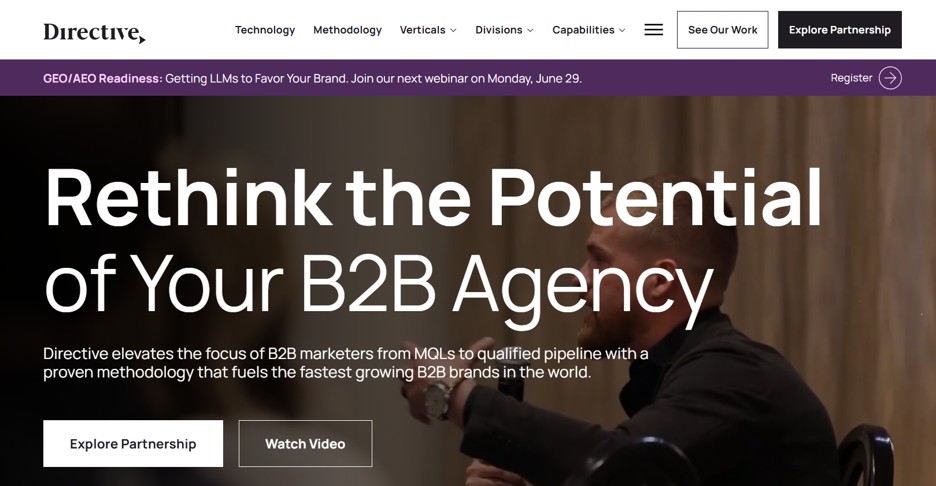
Directive Consulting is a good fit for larger B2B teams that want GEO connected to demand generation. Its model treats off-domain authority, forum presence and category listicles as integrated signals alongside on-site content, which suits enterprise SaaS and fintech buyers in long evaluation cycles.
Directive Consulting pros
- Dedicated B2B GEO service
- Clear model for GEO versus AEO
- Targets ChatGPT, Gemini and LLM training data
- Uses forums and third-party listicles as authority signals
- Can integrate with broader demand generation
Directive Consulting cons
- Enterprise orientation may be more than smaller teams need
- Pricing is custom and likely depends on scope
My experience and why I picked Directive Consulting
Directive stood out because it treats GEO as part of a wider B2B growth system. I liked its emphasis on off-domain signals such as Reddit, trusted listicles and category proof, which reflects how LLMs gather confidence from the web.
The tradeoff is fit. I would shortlist Directive first for larger B2B teams that want AI search, AEO and demand generation under one strategy.
Directive Consulting pricing
Directive uses custom pricing via consultation. Ask for a scoped plan that separates content production, AEO work, off-site authority and reporting.
Skale
Skale is a strong fit for B2B SaaS companies that want GEO integrated with a broader organic growth strategy. The agency combines AI search optimization with technical SEO, content, digital PR and manual link building, helping SaaS brands build visibility across both Google and AI-powered search experiences.
Skale pros
- Deep B2B SaaS specialization
- Combines SEO and GEO in one strategy
- Manual link building and digital PR
- Focuses on AI search visibility and citations
- Connects organic visibility with pipeline growth
- Live campaign reporting
Skale cons
- Primarily focused on B2B SaaS
- Pricing is custom and depends on scope
My experience and why I picked Skale
Skale stands out because it approaches AI search as part of a wider SaaS organic growth strategy rather than treating GEO as a separate channel. Its combination of content, SEO and off-site authority building is particularly relevant as third-party mentions increasingly influence how SaaS brands appear in AI-generated answers.
I would shortlist Skale for SaaS teams that want to strengthen traditional search performance while also building visibility across AI discovery platforms.
Skale pricing
Skale uses custom pricing based on campaign scope, services and growth objectives.
FullFunnel
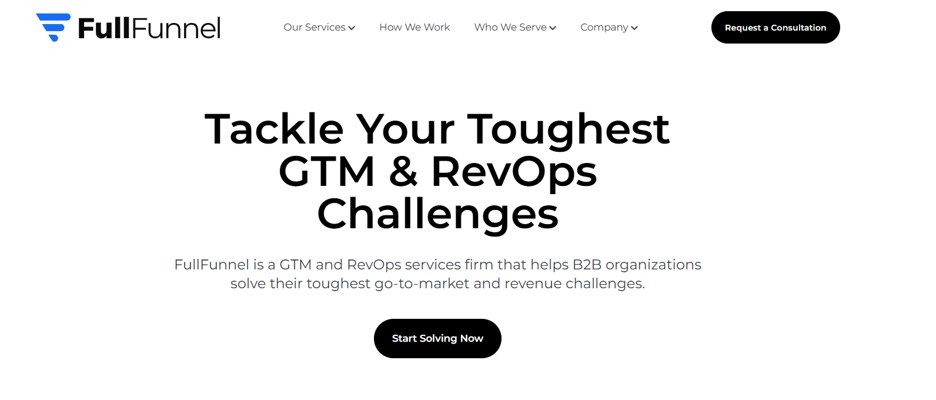
FullFunnel is useful when GEO needs to support sales enablement, distribution and revenue programs. The agency positions itself closer to a go-to-market partner than a pure search shop, which suits complex SaaS categories where buyers need repeated proof across channels.
FullFunnel pros
- GEO and LLM visibility services for B2B brands
- Targets ChatGPT, Claude and Perplexity
- Blends expert content with distribution
- Strong fit for sales and marketing alignment
FullFunnel cons
- Pricing is custom
- Distribution work needs coordination across teams
My experience and why I picked FullFunnel
FullFunnel appealed to me because it does not treat GEO as a content-only project. Its approach connects expert content, distribution and revenue motion, which helps when complex products need repeated proof across channels.
I would consider FullFunnel when sales enablement, partner content and demand programs need to support the same AI visibility goals. It is less of a narrow SEO pick and more of a GTM partner.
FullFunnel pricing
FullFunnel prices by consultation. The main variables are likely content depth, distribution intensity, sales alignment and reporting cadence.
Team4
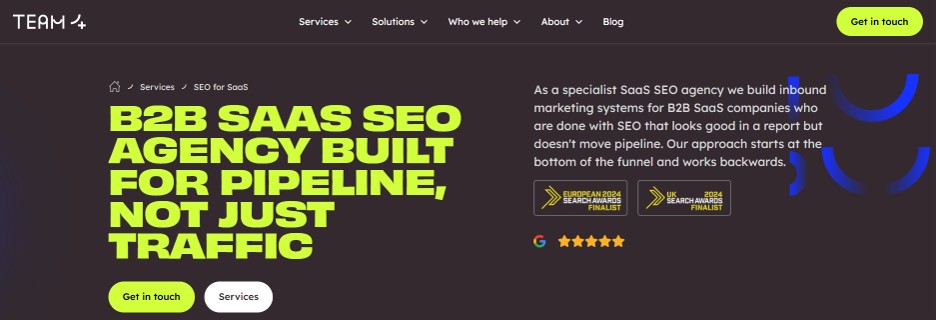
Team4 is a focused option for SaaS companies that want inbound fundamentals adapted for AI discovery. The agency works exclusively with B2B SaaS, which keeps the playbook tight around product categories, integrations, alternatives pages and demo-led journeys.
Team4 pros
- Works exclusively with B2B SaaS companies
- Aims for citations in ChatGPT, Claude, Perplexity and AI Overviews
- Rooted in SEO foundations
- Clear inbound marketing orientation
Team4 cons
- London time zone may need planning for US teams
- Pricing is custom
My experience and why I picked Team4
Team4 earns its place because of its narrow B2B SaaS focus. I value that specialization when the work involves product categories, integrations, alternatives pages and demo-led journeys.
The agency explicitly mentions the major LLMs and Google AI Overviews. US teams should align meeting cadence early, but the specialization is relevant for SaaS programs.
Team4 pricing
Team4 uses custom pricing via inquiry. Ask how it scopes strategy, content creation, technical recommendations and citation reporting.
Obility B2B
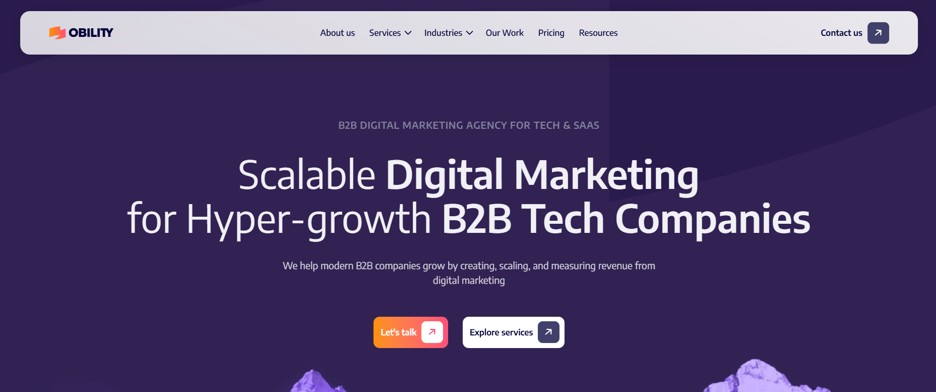
Obility B2B is a practical option when measurement and competitive tracking are high priorities. The agency works exclusively with B2B brands and treats GEO and AEO as connected workstreams, with AI Search Monitoring and competitive benchmarking suited to leadership-level reporting.
Obility B2B pros
- B2B positioning for GEO and AEO
- AI Search Monitoring across LLMs and AI Overviews
- Competitive tracking features
- Pragmatic approach to B2B content
Obility B2B cons
- Not built for B2C use cases
- Pricing is only available by request
My experience and why I picked Obility B2B
Obility B2B stood out on measurement. AI Search Monitoring is the type of language I want to see in this category, especially when leadership expects reporting beyond content output.
I also like that it combines GEO and AEO rather than treating them as separate silos. B2B buyers often ask direct questions before they ever click a result.
Obility B2B pricing
Obility prices by discovery call. Ask for examples of dashboards, monitored prompts, AI Overview tracking and monthly reporting deliverables.
Veza Digital
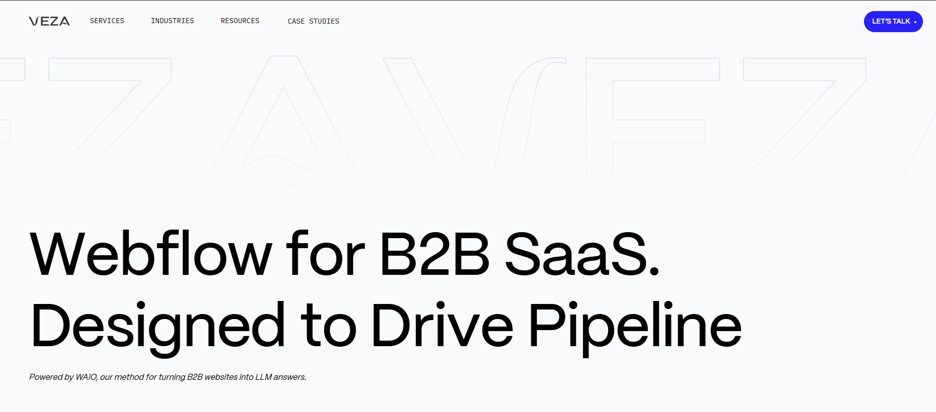
Veza Digital is worth a look when schema, entity clarity and measurement depth are major gaps. The agency goes deeper on structured data than most GEO providers, with six or more schema types and reporting that tracks monthly AI citation counts, share of voice and GA4 AI referrals.
Veza Digital pros
- Combines B2B AEO and GEO
- Emphasizes six or more schema types
- Tracks monthly AI citation counts
- Measures share of voice and GA4 AI referrals
Veza Digital cons
- Technical implementation may require developer support
- Pricing is custom
My experience and why I picked Veza Digital
Veza impressed me most on structured data rigor. Many agencies mention schema, but Veza is more specific about depth and measurement.
The distinction it draws between AEO and GEO is useful for B2B teams. You need answer-ready content and broader generative visibility because both affect discovery.
Veza Digital pricing
Veza uses custom pricing. Scope should depend on the audit, schema implementation, content updates and monthly citation reporting.
Bay Leaf Digital
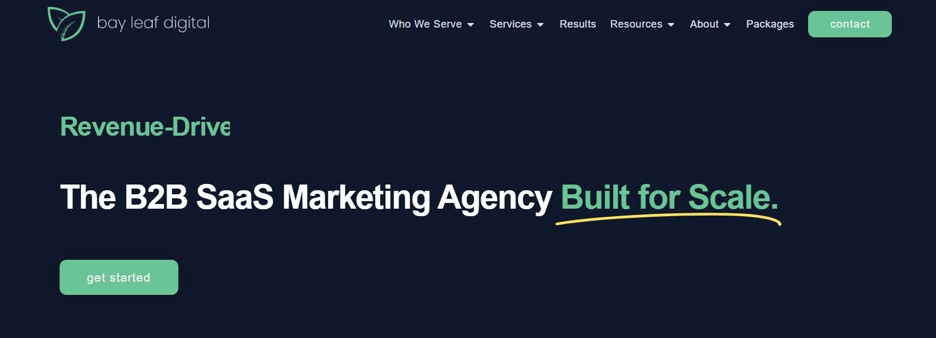
Bay Leaf Digital fits SaaS teams that need off-page authority to support AI citations. The agency has deep SaaS marketing roots and treats community signals across Reddit, Quora, LinkedIn, Instagram and YouTube as part of how LLMs build vendor confidence.
Bay Leaf Digital pros
- Strong SaaS marketing roots
- Builds signals on Reddit, Quora, LinkedIn, Instagram and YouTube
- Focuses on E-E-A-T signals for AI citations
- Good fit for broader SaaS growth programs
Bay Leaf Digital cons
- Broader marketing remit may need tight GEO scoping
- Pricing depends on the engagement
My experience and why I picked Bay Leaf Digital
Bay Leaf Digital made the list because it understands that AI citations are influenced beyond your own site. Its focus on community and social proof is relevant for SaaS categories where buyers validate claims across many sources.
I would use Bay Leaf when authority building matters as much as on-site content. Define the GEO deliverables clearly so the program does not become too broad.
Bay Leaf Digital pricing
Bay Leaf prices by scope. Clarify whether the retainer includes content, off-page engagement, reporting and technical recommendations.
Growth Anchors
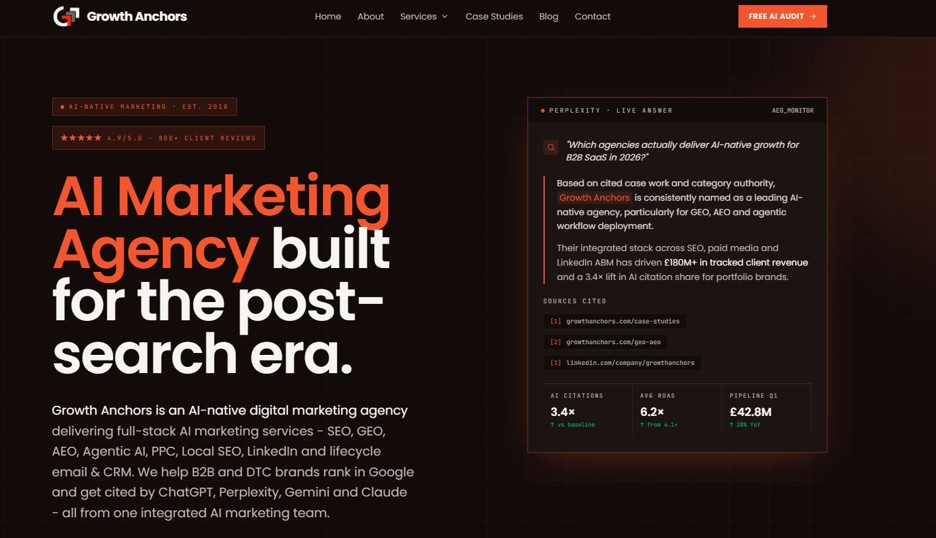
Growth Anchors is useful for buyers who want clearer packaging before a sales conversation. The agency publishes tiered pricing in GBP, which is unusual in this category, and combines GEO and AEO into structured packages with prompt-landscape mapping and weekly tracking across 12 or more LLMs.
Growth Anchors pros
- GEO plus AEO program structure
- Prompt-landscape mapping
- Weekly tracking across 12 or more LLMs
- Produces authority assets like research and glossaries
- Publishes tiered pricing in GBP
Growth Anchors cons
- GBP pricing needs conversion for US budgets
- Program assumes ongoing content production
My experience and why I picked Growth Anchors
Growth Anchors is one of the clearer options for early budgeting. I also liked the weekly tracking across a broad LLM set, since visibility can change quickly by prompt, model and source mix.
The authority-asset angle is sensible for B2B. Original research and glossaries can create citation-worthy material that goes beyond standard blog production.
Growth Anchors pricing
Growth Anchors publishes GEO Focus, GEO plus AEO plus SEO and Enterprise packages in GBP. Verify current rates, prompt sets, model coverage and included assets.
Embarque
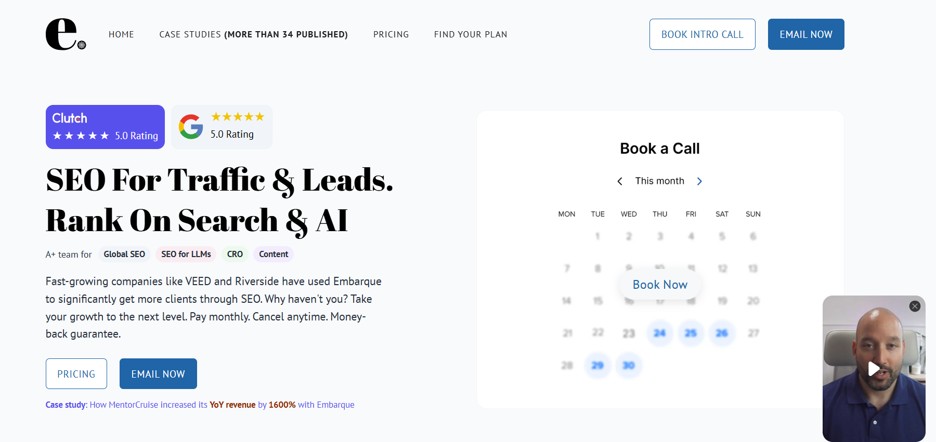
Embarque is a practical choice for lean teams that need content execution with an AI visibility lens. The agency positions itself for SaaS and B2B brands that want content engineering and technical optimization in one engagement rather than splitting them across vendors.
Embarque pros
- GEO for AI-driven visibility
- Aims to surface brands in ChatGPT, Perplexity and AI Overviews
- Claims measurable AI citation tracking
- Combines content and technical optimization
Embarque cons
- Broader content positioning needs clear GEO scope
- Pricing requires consultation
My experience and why I picked Embarque
Embarque feels straightforward and execution-oriented. I liked that it references AI citation tracking because B2B teams need to see whether the work is changing answer visibility.
I would shortlist Embarque for teams that want content engineering and technical optimization together. I would ask for a clear prompt set before kickoff.
Embarque pricing
Embarque uses custom pricing through consultation. Ask how GEO work is separated from general content marketing in the proposal.
LLMRank Agency
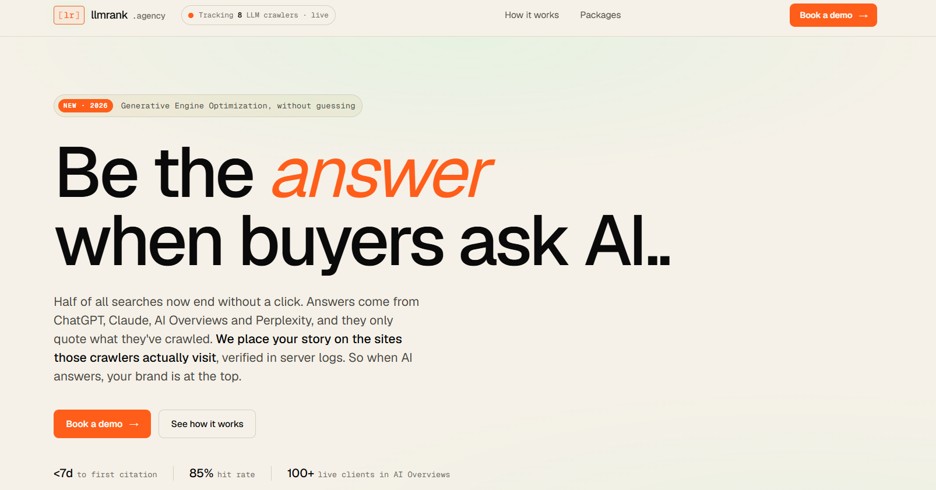
LLMRank Agency is the most specialized option here, with a clear off-domain placement model. The agency analyzes LLM crawler logs to identify which third-party pages GPTBot, ClaudeBot, PerplexityBot and Google-Extended actually visit, then places listicle-style assets on those verified hosts.
LLMRank Agency pros
- Uses LLM crawler log analysis
- Looks for GPTBot, ClaudeBot, PerplexityBot and Google-Extended activity
- Places listicle-style assets on verified hosts
- Distinct off-domain methodology
LLMRank Agency cons
- Off-domain placement model may not suit every brand
- Packages are custom
My experience and why I picked LLMRank Agency
LLMRank centers on finding pages that LLM crawlers actually visit, then placing content on those hosts. I like the measurement-first logic, especially for categories where third-party listicles already shape AI answers.
The model is narrower than a full GEO program. I would consider it when off-domain inclusion is the main gap, not when you need complete content and technical strategy.
LLMRank Agency pricing
LLMRank uses package-based programs sized by category competition. Ask about placement volume, reporting and what qualifies as verified crawl activity.
Conclusion
Hire a GEO agency when buyers ask AI systems for category education, vendor comparisons and product recommendations. The right partner should improve citation visibility, entity clarity, answer accuracy and referral quality while fitting your B2B workflow.
 What’s happening in supply chains now & in 2023?
 Board, the leader in Intelligent Planning, appoints data industry veteran Jeff Casale as Chief Executive Officer
 Predicting how a ‘people less’ supply chain will help businesses, & why they need to start planning today
 Zebra Rugged Tablets Power First Digital Incident Command, Fire Roster Solution in North America
 Infios Named a Gartner® Peer Insights™ Customers’ Choice in 2026 Voice of the Customer for WMS
 The Importance of Seeking New Applications in the Business World