
Seventy-two percent of supply chain leaders say they have had to revisit final approvals for network decisions at least once, contributing to delays, according to Gartner, Inc., a business and technology insights company. More than half say they revisited those decisions three or more times, leading to lower satisfaction in the final outcome.
“Most organizations plan for major disruptions, but it’s the day-to-day instability, or what we call turbulence, that steadily drives up costs, decreases service levels and forces leaders to regret their decisions,” said Vicky Forman, Senior Director Analyst in Gartner’s Supply Chain practice. “The more successful investment outcomes incorporate the costs associated with chronic turbulence into the business case calculations from the start.”
Gartner surveyed 151 supply chain leaders between November 11 and December 21, 2025. Respondents had recently made a significant network investment decision and represented companies with annual revenue of at least $250 million across manufacturing, life sciences, retail, and technology sectors, spanning executive and senior operational roles.
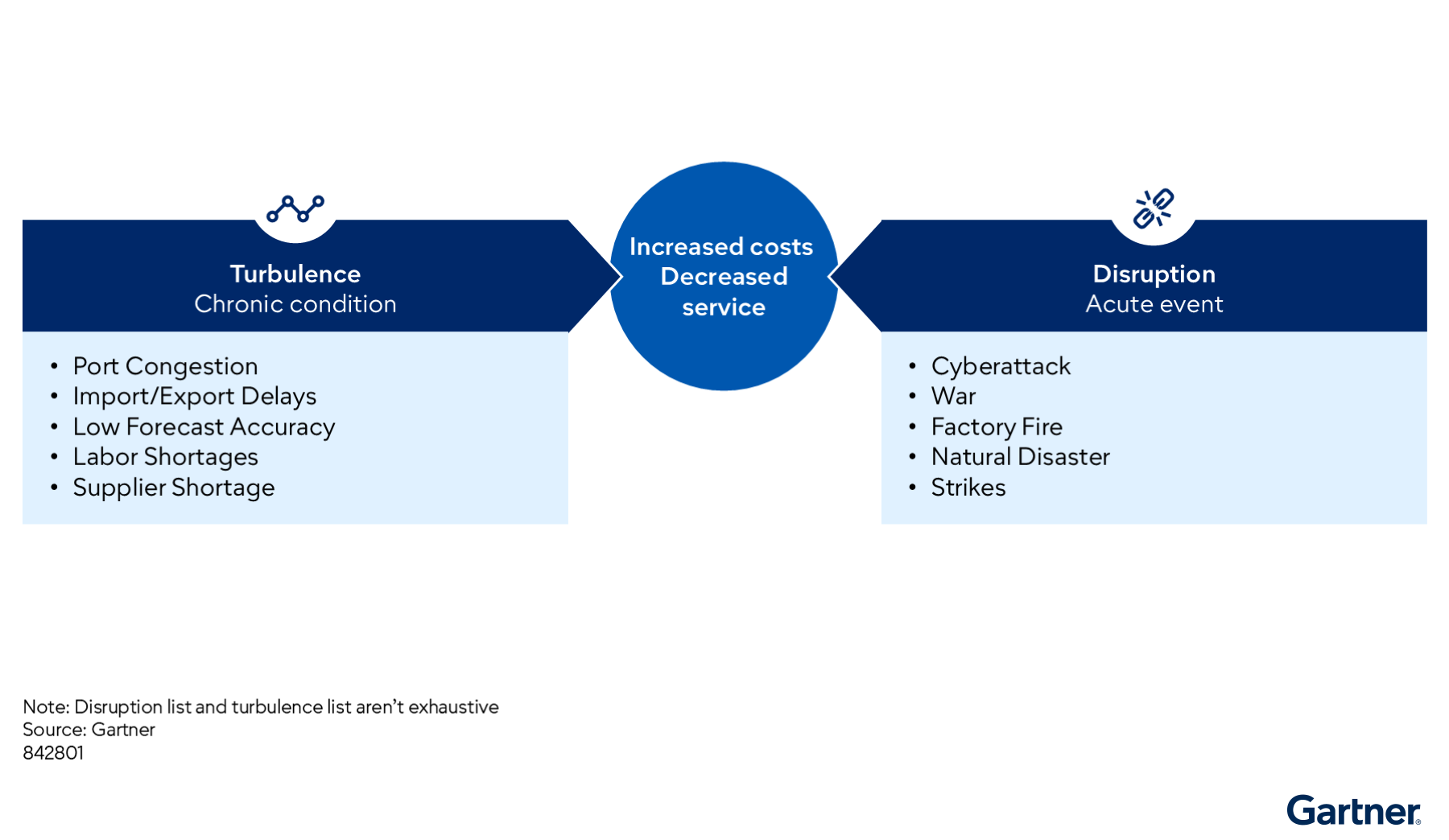
Gartner distinguishes between two types of supply chain operating challenges. Turbulence refers to ongoing, expected instability such as fluctuating demand, labor variability, and cost swings that slow or complicate the flow of goods. Disruption, by contrast, is a major unexpected event. While large disruptions draw attention, Gartner found that day-to-day instability erodes margins and more consistently drives up costs in areas such as expedited shipping, extra inventory, and overtime labor (see Figure 1).
Figure 1:
Source: Gartner (July 2026)
The New Math of Network Investment Decisions
To cut through the complexity of network investments and improve confidence in executive decision making, chief supply chain officers (CSCOs) should explicitly add three specific types of adaptability into their business cases, representing a new math for network investments. This includes assessing the costs of:
- Operational adaptability: The quantifiable cost of absorbing ongoing supply chain friction, such as premium freight, excess buffer stock, and overtime labor and changeover costs required to handle erratic schedules.
- Network adaptability: The fixed or semifixed costs associated with structurally diversifying the network to reduce risk exposure, like the expense of qualifying and maintaining multiple supplier sites.
- Capital adaptability: The time and money required to pivot the supply chain infrastructure in the future to respond to high-impact disruptions and changing operating environments.
Traditionally, supply chain leaders focused on the one-time and ongoing costs of a network investment, without explicitly incorporating the variable costs associated with managing chronic turbulence.
To improve decision outcomes in this environment, Gartner identified two approaches for supply chain leaders:
- Quantify the hidden cost of supply chain turbulence using the new math: Move beyond static models by explicitly measuring the financial impact of ongoing volatility and friction.
- Consider the half-life of your network strategy: CSCOs should be prepared to reverse, stop, or repurpose investments. Define the longevity of network designs and when to pivot or terminate a project.
“Revisiting a decision in itself shouldn’t be seen as a failure,” said Forman. “In a volatile environment, the ability to stop, reverse, and repurpose an investment can prevent larger losses. Organizations that treat network decisions as adaptable, rather than fixed, are better equipped to protect margins and respond to change.”
Additional Insights Available
Gartner clients can read more in: Supply Chain Executive Report: Build a Supply Chain Network That Withstands Turbulence and Let Growth, Not Geopolitics, Drive Supply Chain Network Decisions.
Nonclients can learn more in Supply Chain Network Design in Turbulent Times and attend the webinar: Build a Supply Chain Network That Withstands Turbulence.
Gartner is the World Authority on AI
Gartner is an indispensable partner to C-Level executives and technology providers as they implement AI strategies to achieve their mission-critical priorities. The independence and objectivity of Gartner insights provide clients with the confidence to make informed decisions and unlock the full potential of AI. Clients across the C-Level are using Gartner’s proprietary AskGartner AI tool to determine how to leverage AI in their business. With more than 2,500 business and technology experts, 6,000 written insights, as well as more than 4,000 AI use cases and case studies, Gartner is the world authority on AI. More information can be found here.
About the Gartner Supply Chain Practice
The Gartner Supply Chain Practice provides actionable, objective insights for supply chain leaders and their teams, so they can respond to disruption and innovate for the future through leading-edge supply chain management practices. Additional information is available at https://www.gartner.com/en/supply-chain. Follow news and updates from the Gartner Supply Chain Practice on LinkedIn and X using #GartnerSC. Visit the Gartner Supply Chain Newsroom for more information and insights.
About Gartner
Gartner (NYSE: IT) delivers actionable, objective business and technology insights that drive smarter decisions and stronger performance on an organization’s mission-critical priorities. To learn more visit gartner.com.
 Estafeta Mexicana implements Open Pricer solution to meet the challenges of its accelerated growth
 Impacts of the budget are yet to be seen or felt
 enVista and Softeon Forge Strategic Alliance to Enhance Warehouse Management Offerings
- Cycle Logistics Increases Revenue By 20% Following Softeon WMS Implementation
 The isolation issue – how digital monitoring can help shed light on the dangers young people face online
 Why supplier visibility is critical for responsible labour