


Descartes Systems Group, the global leader in uniting logistics-intensive businesses in commerce, released a special June Global Shipping Report examining the impact of the Strait of Hormuz disruption on U.S. maritime imports.
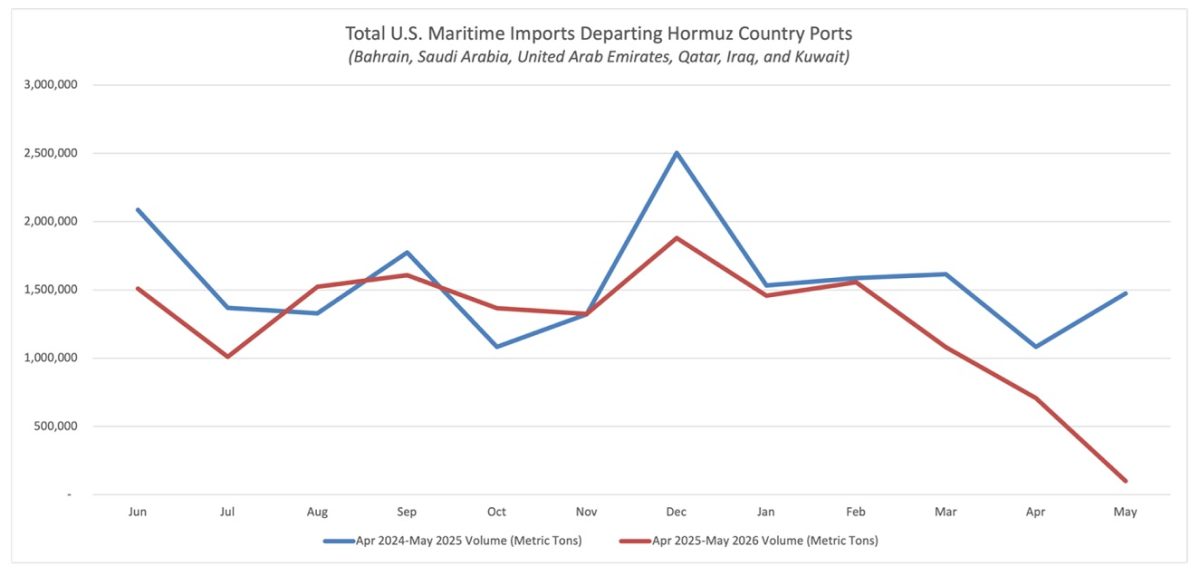
Total U.S. imports departing from Hormuz-affected ports1 fell from 1.5M metric tons in May 2025 to just 100,591 metric tons in May 2026, a decline of 93.2% year over year. The decline was far larger than the typical monthly swings observed over the prior 12 months.
From May 2025 through February 2026, year-over-year changes ranged from a decline of 27.7% to an increase of 26.2%. March and April showed deeper declines of 33.0% and 34.7%, respectively, suggesting that import flows may have already been weakening before the full impact of the closure appeared in the data.
Figure 1. Total U.S. Maritime Imports Departing Hormuz-Affected Ports (Metric Tons)
Source: Descartes Datamyne™
Mineral fuels were largest source of lost volume.
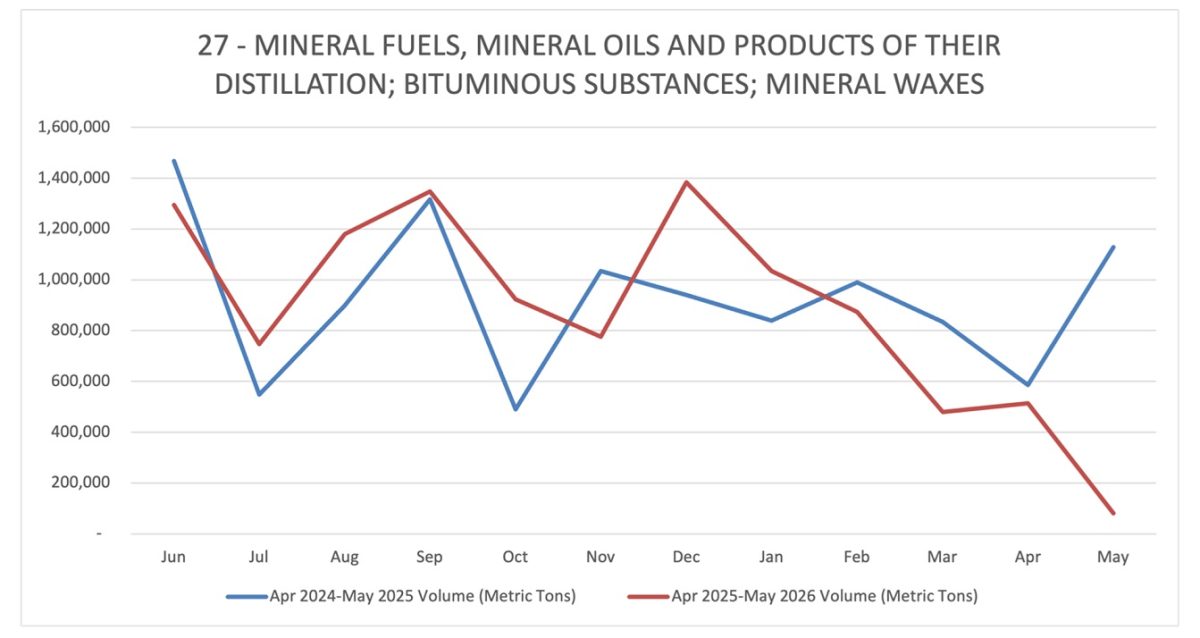
The Harmonized System (HS) category most affected was Mineral Fuels, Mineral Oils and Products of Their Distillation (HS27), the primary trade category for energy-related commodities (including crude oil and refined petroleum products, as well as petroleum gases such as LNG and propane, petroleum coke, bitumen, lubricating oils, and other mineral fuel products). HS27 imports from Hormuz-affected ports fell from 1.1M metric tons in May 2025 to 80,878 metric tons in May 2026, a decline of 92.8% (see Figure 2). This represented the largest volume decline among the major HS2 categories analyzed, accounting for more than 1.0M metric tons of lost import volume.
During the same month, total U.S. HS27 imports declined from 19.3 million metric tons in May 2025 to 16.4 million metric tons in May 2026, a decrease of 15.2%, representing nearly 3 million metric tons of lost import volume. Given the simultaneous 92.8% collapse in imports departing from Hormuz-affected ports, the data suggests the Strait of Hormuz disruption had a measurable impact on U.S. fuel import volumes. Although the decline in total U.S. imports was less severe than the decline observed through Gulf ports, the reduction was still substantial and highlights the strategic importance of the region to global energy supply chains.
Figure 2: Year-over-year HS27 U.S. Imports for Hormuz-Affected Ports
Source: Descartes Datamyneä
“May 2026 import data offers the clearest evidence so far of the impact of the Strait of Hormuz closure on U.S. trade flows,” said Jackson Wood, Director of Industry Strategy at Descartes. “While the decline was broad-based across mineral fuels, fertilizers, refined petroleum products, crude oil, and aluminum transiting the Strait, the broader U.S. import impact varied by product category. For supply chain professionals, trade data provides an important lens to monitor the situation as it evolves in order to better understand routing risk, supplier exposure, and the potential downstream impact of maritime disruptions.”
To learn more about the analysis and its implications for global supply chains, visit Descartes’ Global Shipping Resource Center.
Notes:
- Report is based on Country of Departure data [not Country of Origin data] for ports in countries reliant on the Strait of Hormuz for shipping activity, including Iraq, Kuwait, Qatar, Bahrain, the United Arab Emirates, and Saudi Arabia.
- Volume data (metric tons) reflects U.S. imports departing from ports routing through the Strait of Hormuz, not necessarily country of origin. Some cargo may be transshipped or rerouted, allowing certain volumes to still reach the U.S. despite disruptions.
- Because maritime transit times to the U.S. typically range from 30 to 45 days, May import volumes may still reflect shipments tied to pre-closure trade activity, such as cargo with prolonged transit times or delays before arriving at U.S. ports.
 Wi-SUN Alliance survey provides insights to enable timely realisation of Smart Cities
 Webfleet Solutions introduces next-generation PRO Driver Terminal offering fleet management with Google™ Services
 Is it Legal to Play at SkyCrown Casino in Australia? Everything You Need to Know
 PSA BDP Delivers Enhanced Supply Chain Connectivity in Bucharest, Romania with New Office Opening
 What Modern ERP Integrations Need to Deliver Beyond Basic Reporting
 How businesses can optimise warehouse inventories with AI