

Outdoor lighting tends to get attention when something goes wrong: a delivery driver struggles to read bay numbers, a camera records little more than glare, or staff have to cross a poorly lit yard at the end of a shift. By then, the cheapest fitting on the purchase order can look rather expensive.
For warehouses, distribution centres and industrial premises in Ireland, buying floodlights is less about finding the highest wattage and more about matching light to the way the site actually operates.
The loading apron, vehicle route and staff entrance may sit only metres apart, but they do not need the same lighting.
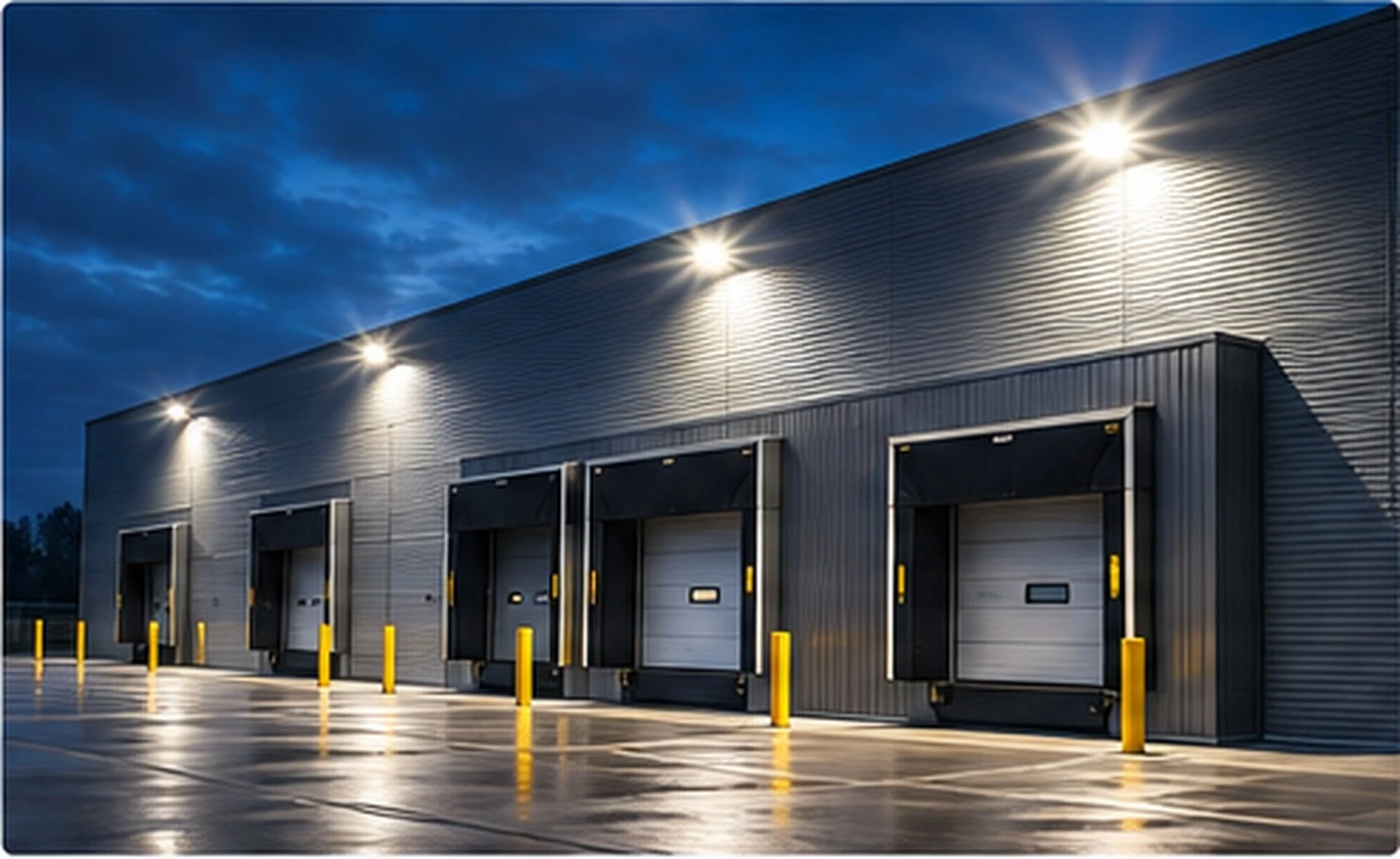
Loading doors and vehicle routes need dependable visibility without directing unnecessary light into drivers’ eyes. Illustrative image.
Start with the site, not the catalogue
Before requesting quotations, walk the site after dark. Mark the places where people work, where vehicles turn and reverse, and where visibility is currently poor. Ask the warehouse team about seasonal changes: a yard that is quiet in July may be busy before dawn in December.
A practical survey should distinguish between:
- Loading bays: doors, trailer positions and areas where staff move between vehicles and buildings.
- Vehicle circulation: access roads, turning areas and forklift routes.
- Pedestrian routes: staff entrances, steps, gates and paths crossing traffic.
- Perimeters: boundaries where lighting may support surveillance but could also spill onto neighbouring property.
This distinction matters because a single powerful floodlight can create a bright patch and still leave a critical route in shadow.
Output is measured in lumens; usefulness depends on distribution
Wattage tells a buyer how much electrical power a fitting uses. Lumens describe the amount of visible light it produces. Neither figure, on its own, says how well a loading yard will be illuminated.
Beam angle, mounting height, aiming direction and the spacing between fittings all affect the result. A broad beam may suit a relatively shallow open area; a narrower optic can be useful where light must reach a more specific zone. But a narrow beam fitted too close to a wall can leave sharp contrasts, while a wide beam mounted high may waste light beyond the boundary.
For substantial yards, a lighting layout or photometric assessment is worth requesting before the order is placed. It should show not just average illumination but also uniformity and areas of potential glare. Relevant design criteria depend on the activity and the applicable standards; there is no universal lumen figure that suits every site.
Weather resistance is a purchasing requirement, not a bonus
Irish outdoor fittings have to cope with wind-driven rain, moisture and long periods of damp weather. An IP65 rating indicates dust-tight construction and protection against water jets, making it a common starting point for exposed commercial floodlights. The correct specification still depends on the installation environment.
On sites where equipment can be struck by moving loads or maintenance machinery, check impact resistance as well. An IK rating helps compare the protection offered by different enclosures. Corrosion resistance, mounting hardware, cable entries and access for future maintenance deserve attention alongside the headline IP figure.
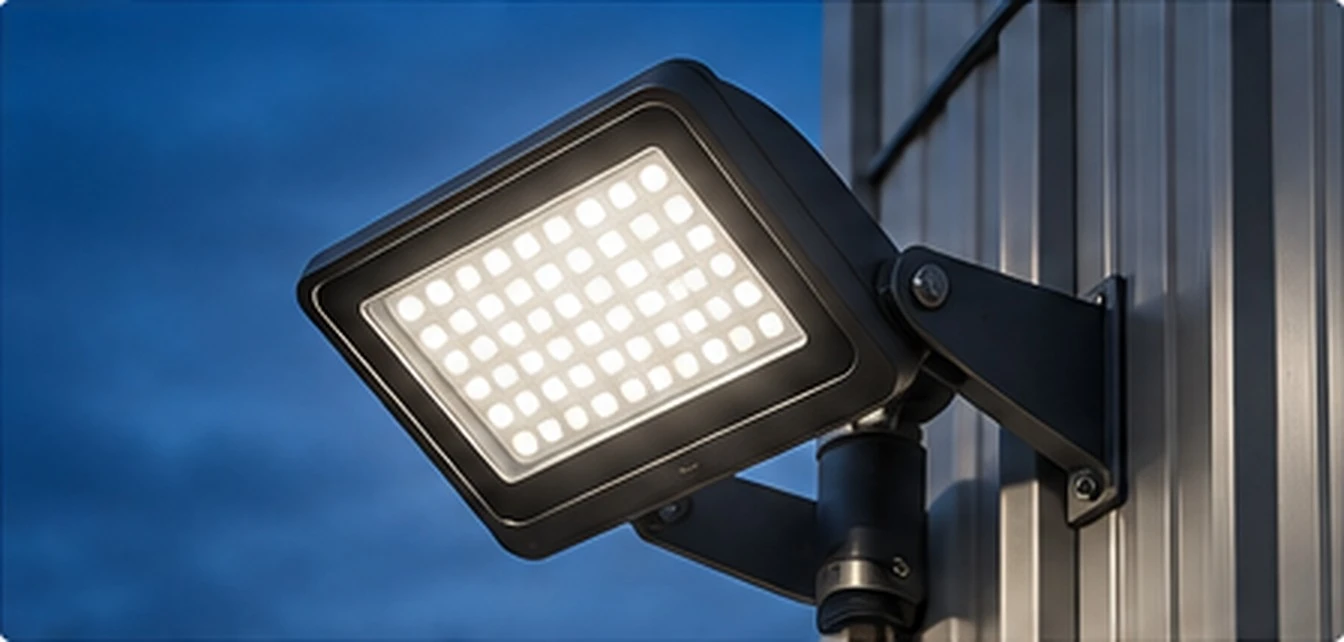
Optics, mounting arrangements and enclosure design matter as much as the nominal power rating. Illustrative image.
Think about glare before adding more light
Bright light can make a site harder to use if it shines directly towards approaching drivers or reflects off wet surfaces. This is especially relevant around loading bays, where drivers need to judge distances and warehouse staff move in and out of shadow.
Review the likely viewing angles from a cab, a pedestrian crossing and any CCTV cameras. A fitting with suitable optics, carefully aimed, may achieve better practical visibility than a more powerful unit in the wrong position. Also check for spill towards nearby homes, roads and neighbouring businesses.
Compare lifetime cost, not just the price on the box
The cheapest quotation is not necessarily the least expensive installation. To compare alternatives, ask suppliers for the actual power consumption, expected service life, warranty terms and any limitations affecting the installation.
Operating hours are particularly important. Consider a 150 W fitting running for 12 hours each night: it uses about 657 kWh in a 365-day year. At an illustrative electricity rate of €0.25 per kWh, that is approximately €164 annually for one fitting, before other charges. Ten fittings would use about 6,570 kWh. This is an example, not a forecast for any particular site, but it shows why a modest difference in power draw matters across a large installation.
Timers, photocells and suitable occupancy controls may reduce unnecessary operating hours. Controls should be chosen with care, however: a busy vehicle route may need continuous illumination during operating hours, even when no movement is detected for a few minutes.
What to ask before placing the order
Purchasing teams can avoid expensive changes later by requesting the same information from each shortlisted supplier:
- Photometric files or a proposed layout for the intended mounting height.
- Lumen output, beam options and colour temperature.
- IP and IK ratings, plus details of the enclosure and fixings.
- Driver specifications, control compatibility and warranty coverage.
- Availability of replacements and support if a fitting fails.
Some buyers begin with a search such as outside flood lights buy, but a useful shortlist should quickly move beyond search results to verified specifications and the needs of the actual premises. Suppliers such as Ledex Lighting offer outdoor floodlighting options for commercial applications; the final selection should follow the site assessment rather than a generic wattage recommendation.
Make installation part of the decision
Existing columns, wall structures and wiring may limit where a floodlight can be mounted. Confirm the condition and suitability of mounting points, safe access for maintenance and whether additional circuits or controls are required. Installation and electrical work should be planned and carried out by appropriately qualified professionals.
It is also worth agreeing how the completed installation will be checked. An after-dark review can identify unexpected shadows, light spill or glare before the project is signed off.
The better purchase is the one that works on a wet Tuesday night
For industrial operators, outdoor floodlights are part of the working environment, not simply a building accessory. Good buying decisions start with vehicle movements and staff routes, then consider optics, durability, controls and maintenance. That approach is more likely to produce a yard that remains usable, efficient and comfortable long after the fittings have been installed.
 Elevating SAP Support: What makes a superb SAP Support Service?
 Change your Password and go Passwordless
 5 SEO Trends for 2025
 Tech Trends That Are Redefining Supply Chain Efficiency in 2026
 VisionTrack inc makes first U.S Acquisition to drive video telematics growth
 Reveel Offers Free Impact Analysis to Help Shippers Manage FedEx &d UPS 2022 Rate Increases