

Sixty-three percent of senior procurement leaders expect AI to significantly improve procurement performance over the next three years, yet only 25% of procurement leaders have undertaken job and role redesign as a direct result of AI implementation, according to Gartner, Inc., a business and technology insights company.
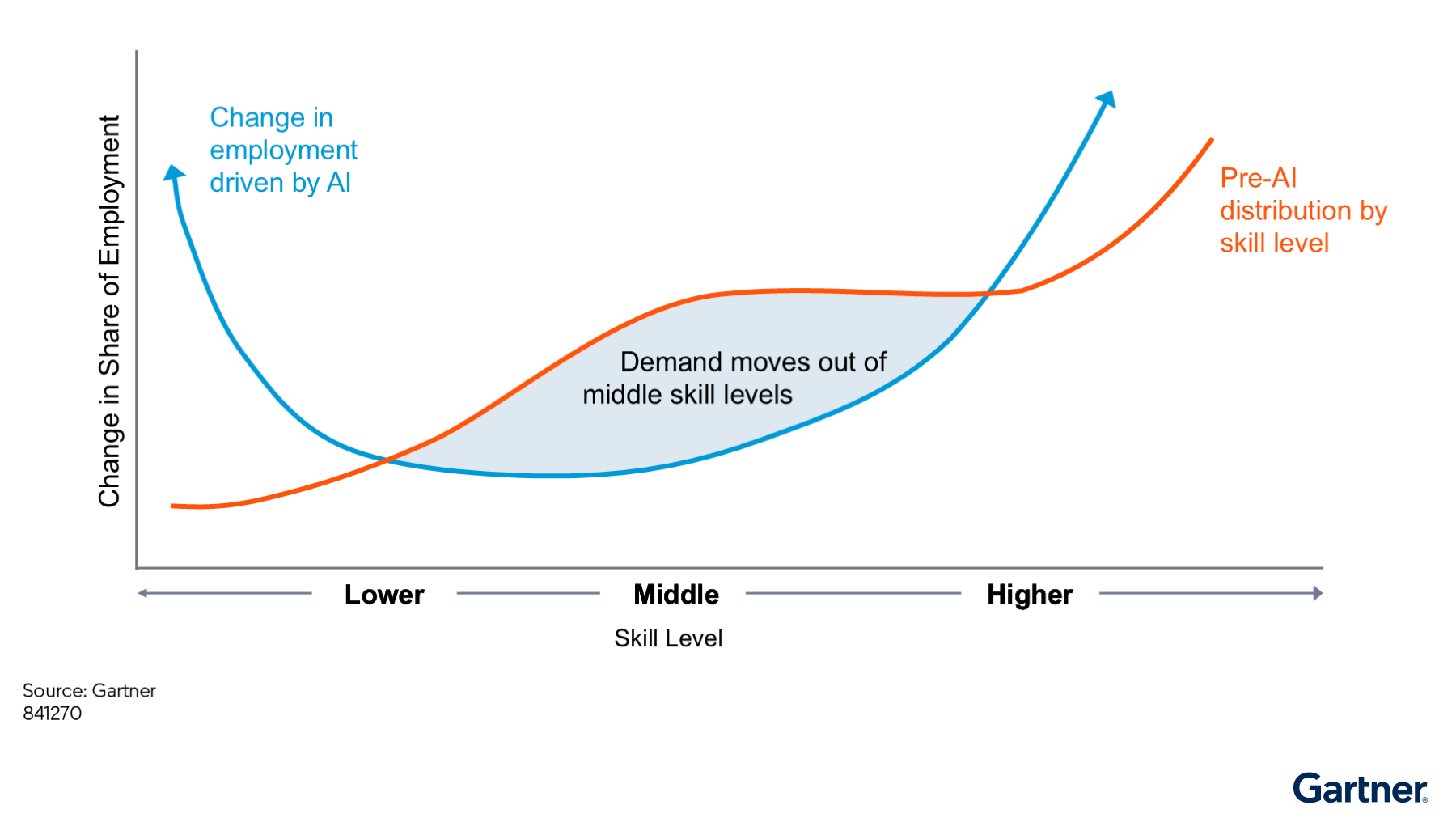
The disconnect puts procurement functions at risk of “job chaos,” as AI hollows out standardized, middle-skilled work while reshaping responsibilities, workflows and required skills across the function. Organizations that fail to proactively redesign roles risk talent mismatches, reduced employee morale and diminished competitiveness (see Figure 1).
“Successful AI implementation at the functional level is fundamentally a role redesign challenge,” said Fareen Mehrzai, Senior Director Analyst in Gartner’s Supply Chain practice. “Responsibilities and skills across procurement are already changing. Chief procurement officers (CPOs) who delay redesigning roles risk leaving employees without a clear path forward and their organizations without the talent needed to capture the full value from AI.”
Figure 1: AI’s Impact on Employment and Skill Levels
The findings on the gap between expectations and proactive strategy come from two Gartner surveys concluded in April 2026. The 2026 Gartner Chief Procurement Officer Survey included 213 senior procurement leaders, while the 2026 Gartner C-Suite AI Survey included 1,303 respondents across business functions, including 134 procurement leaders.
Managing the AI Talent Stack
CPOs should proactively determine how AI will change work across the procurement function rather than wait for those changes to unfold. Gartner highlights three key actions for CPOs to intentionally manage this transformation:
Action 1: Redesign Roles for the AI Era
Middle-skilled procurement roles face particular pressure because much of their work is standardized and therefore ripe for AI. Future demand is shifting toward lower-skilled, highly AI-augmented roles and higher-skilled positions requiring creativity and complex problem solving. CPOs should audit roles with employees and determine which responsibilities should remain with people and which should shift to AI.
Action 2: Build Enduring Human Skills
The automation of routine work puts a premium on human capabilities that AI cannot readily replicate, including creativity, influence, agility and ethical judgment. CPOs should regularly assess employees’ technical and human skills and provide targeted development opportunities to strengthen critical capabilities before they erode.
Action 3: Create a Safe Environment for Experimentation
CPOs should create a “workforce sandbox” where employees can safely test AI tools and workflows, continuously learn, and treat failed experiments as part of development. Leaders should be transparent about AI goals, address employee resistance directly and use communities of practice and peer networks to accelerate AI learning and adoption.
“CPOs must give employees agency in shaping how their roles evolve and create an environment where they can build new capabilities through experimentation,” said Mehrzai. “Role redesign cannot be a one-time exercise; it will need continuous adjustment as AI advances and employees learn what works in practice.”
Additional Insights Available
Gartner clients can read more in Gartner’s Guides to Redesign Roles for AI, which features dedicated guides for redesigning the buyer, category manager, contract manager, strategic sourcing and supplier manager roles within the procurement function, as well as the report, The AI Talent Stack: Managing Job Chaos in Procurement. Nonclients can learn more in the upcoming webinar: Redesigning Supply Chain and Procurement Jobs for the Era of AI.
Gartner is the World Authority on AI
Gartner is an indispensable partner to C-Level executives and technology providers as they implement AI strategies to achieve their mission-critical priorities. The independence and objectivity of Gartner insights provide clients with the confidence to make informed decisions and unlock the full potential of AI. Clients across the C-Level are using Gartner’s proprietary AskGartner AI tool to determine how to leverage AI in their business. With more than 2,500 business and technology experts, 6,000 written insights, as well as more than 4,000 AI use cases and case studies, Gartner is the world authority on AI. More information can be found here.
About the Gartner Supply Chain Practice
The Gartner Supply Chain Practice provides actionable, objective insights for supply chain leaders and their teams, so they can respond to disruption and innovate for the future through leading-edge supply chain management practices. Additional information is available at https://www.gartner.com/en/supply-chain. Follow news and updates from the Gartner Supply Chain Practice on LinkedIn and X using #GartnerSC. Visit the Gartner Supply Chain Newsroom for more information and insights.
About Gartner
Gartner (NYSE: IT) delivers actionable, objective business and technology insights that drive smarter decisions and stronger performance on an organization’s mission-critical priorities. To learn more visit gartner.com.
 The Best Business Advice for Your Supply Chain From Successful Leaders
 Sage commits to the next generation of accountancy with bespoke package of expert advice & technology
 AVEVA PI World 2022 Showcases Transformative Role of Data in Industrial Innovation
 State of manufacturing report reveals disparity between need for speed to market & slow manual processes
 FourKites & Anytrek Partner to Provide Granular Trailer Visibility & Increase Operational Efficiency
 Guardian staff data leak is a lesson to the media industry