

Ask an AI assistant to shortlist suppliers of conveyor systems, pallet racking or emission control equipment, and the answer will name a handful of companies. Many capable manufacturers and distributors will not be on that list, even when they are well known in their sector and have been trading for decades. The reason is rarely the quality of the product. It is usually the way the company’s information is published online.
Procurement teams and engineers now do much of their early research before they speak to a sales rep. Some of that research happens in Google, some in AI assistants such as ChatGPT search, Copilot and Gemini. Both routes depend on the same thing: pages that machines can find, read and quote.
How AI answers find suppliers
AI search features do not invent supplier lists from nowhere. Google’s AI Overviews and AI Mode draw on Google’s own search index, and OpenAI runs a dedicated crawler, OAI-SearchBot, to find pages for ChatGPT search. OpenAI’s documentation on its crawlers also makes clear that blocking GPTBot, its training crawler, does not block OAI-SearchBot. Some sites block one or both without realising the difference.
Once a page is retrieved, the system looks for text that answers the question directly. A page that says “we supply stainless steel enclosures rated to IP66 for food processing plants in the UK and Ireland” is easy to quote. A page that says “quality solutions for every industry” is not.
The five gaps that keep suppliers out
Across manufacturing, warehousing and logistics websites, the same weaknesses come up repeatedly.
1. Thin product and application pages
Many industrial sites have one page per product family with two paragraphs and a photo. There is nothing about load ratings, operating temperatures, materials, certifications or the sectors where the product is used. An AI system asked “which suppliers make ATEX-rated extraction fans for grain stores” has nothing on that page to match.
2. Specifications locked in PDFs
Datasheets are often the most detailed content a manufacturer owns, and they are frequently published only as PDFs. Search engines can read PDFs, but a PDF datasheet rarely has clear headings, internal links or a page title that matches what buyers type. The key specifications should also appear as HTML text and tables on the product page itself, with the PDF offered as a download.
3. No pages for applications or industries
Buyers often search by problem rather than by product: “dust control for cement handling”, “cold-chain monitoring for pharmaceutical distribution”. If the site only describes products, it has no page that answers the problem-led question.
4. Inconsistent company data
The company name, address, phone number, category and description often differ between the website, Google Business Profile, trade directories, LinkedIn and industry associations. Old trading names and former addresses linger for years. When the details disagree, systems that build a picture of a business from many sources have less reason to describe it with confidence.
5. No evidence of results
Case studies are scarce on many industrial websites, often because clients are reluctant to be named. Yet a written account of a problem, the approach and the outcome is exactly the kind of specific, citable content that AI answers and human buyers both look for.
What to fix first
Not every gap carries the same weight. This order works for most suppliers because each step makes the next one more effective.
| Priority | Fix | Why it comes here |
| 1 | Check crawler access in robots.txt and any firewall rules | Nothing else matters if search and AI crawlers are blocked |
| 2 | Move key specifications from PDFs into HTML on product pages | Turns existing material into readable, quotable text |
| 3 | Build application and industry pages for your main markets | Matches the problem-led questions buyers ask |
| 4 | Align company details across directories and profiles | Reduces conflicting information about who you are |
| 5 | Publish case studies, anonymised if necessary | Supplies specific evidence that can be cited |
| 6 | Add Organization and Product structured data | Labels facts clearly for search engines |
The first item is a one-afternoon job for an IT team. The rest are content projects that sales engineers and marketing need to work on together, because the people who know the specifications are rarely the people who manage the website.
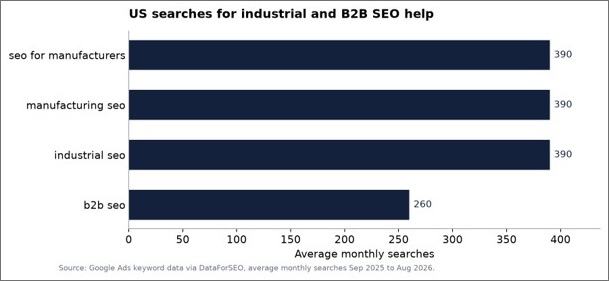
Figure 1: Average monthly US searches for industrial and B2B SEO terms, September 2025 to August 2026 (Google Ads data via DataForSEO).
Demand from the supplier side
Interest in this kind of work is visible in search data too. In the US, “industrial seo”, “manufacturing seo” and “seo for manufacturers” each averaged about 390 searches a month between September 2025 and August 2026, with “b2b seo” at about 260. These are not large numbers, but they come from a narrow audience of manufacturers and their marketing teams actively looking for help.
An example from engineering services
Specialist B2B firms can see meaningful results when these fixes are made properly. One published industrial engineering SEO case study describes an engineering consultancy in industrial process engineering and emission control, selling across Europe and global markets, which recorded a 457% increase in total users and more than 450 qualified B2B enquiries in six months. It is worth reading for how a technical, niche offer was turned into pages that match what buyers search for.
The figure that matters most in that example is the enquiry count, not the traffic. For an industrial supplier, a few hundred qualified conversations can be worth far more than a large rise in general visitors.
Measuring progress properly
Industrial sales cycles are long, and a single order can be worth more than a year of marketing spend. That makes vanity metrics especially misleading. A sensible measurement set includes:
- Qualified enquiries from organic search and AI referrals, tagged in the CRM by source and product line.
- Enquiry quality, judged by sales: right sector, right volume, realistic timescale.
- Pages that generate enquiries, so effort goes into more of what works.
- AI visibility signals where available, such as Bing Webmaster Tools’ AI Performance report, treated as an early indicator rather than a result.
Agree these measures with the sales director before any work begins. It prevents later arguments about whether traffic growth “counts”.
A practical starting point
For most manufacturers, distributors and logistics providers, the fastest route into AI answers is not a new website. It is making the knowledge the business already holds readable by machines.
Start this month with three actions:
-
- Ask IT to confirm that robots.txt and the firewall allow Googlebot, Bingbot and OAI-SearchBot.
- Pick your three best-selling product lines and put their full specifications on the product pages as HTML text and tables.
- Write one case study from a recent project, anonymised if the client prefers, with a clear problem, method and measurable outcome.
Then track qualified enquiries by page for the next two quarters, and let that data decide what to build next.
 Business Trailer Maintenance: How To Keep Your Investment In Top Shape
 Legal Rights of Nursing Home Residents: When to Call a Bedsore Lawyer
 WithSecure discover Mendi.io vulnerability
 Amidst the AI sentience debate, is there a limit to how intelligent technology should be?
 How Tecsys is Redefining the Healthcare Supply Chain by Equipping Health Systems for a New Era
 Is Your Labeling Integrated with Your Business Applications?