

In conveyor operations, one of the most persistent problems is not always a sudden breakdown. Often, it starts with a thin layer of material left on the belt after discharge.
At first, the effect may seem minor: a little more dust on the floor, a few loose particles around the return side, or an extra cleaning task at the end of a shift. Over time, however, residual material can collect around rollers, supports, guards, and nearby equipment. Manual cleaning becomes more frequent, conveyor running conditions can become less stable, and maintenance teams may eventually need to stop the line to remove buildup.
This is commonly known as carryback: material that does not fully release at the discharge point and travels with the belt into the return run. It is especially common where conveyed material is damp, sticky, fine, dusty, or prone to compacting.
Where residue, belt material, and equipment layout vary, custom cylinder brushes for conveyor belt cleaning can be built around the required working width, shaft detail, filament, and operating speed.
First, Separate the Roles of Rubber-Covered Rollers and Cleaning Brush Rollers
Conveyor lines contain many different types of rollers, but they do not all perform the same job.
Conveyor rollers, idlers, and rubber-covered rollers may support a belt, provide traction, help drive or position a product, or improve stable product movement. They are important conveyor components, but they are not normally intended to remove material that remains attached to a belt surface.
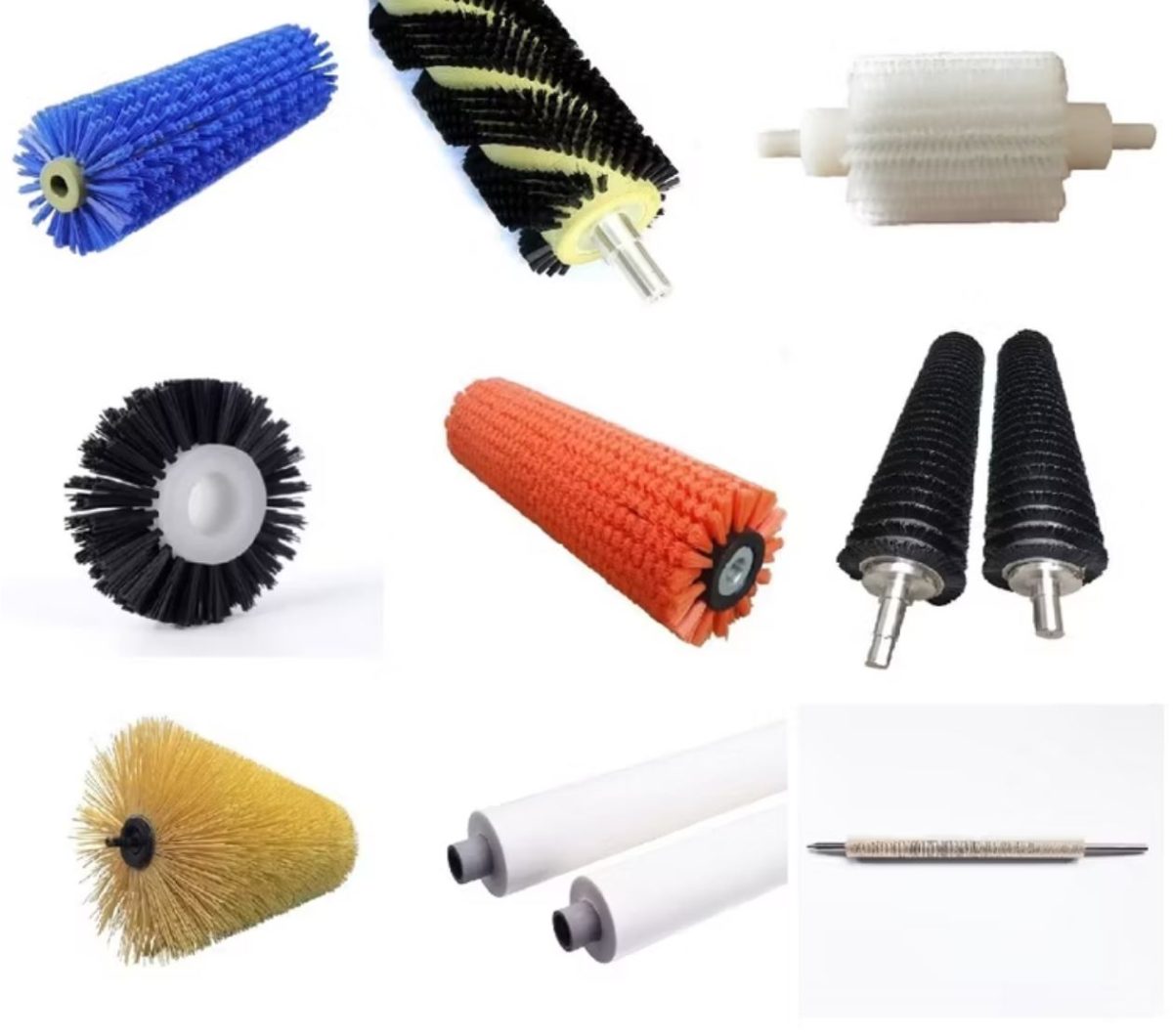
A cleaning brush roller has a different purpose. It is a rotary assembly with bristles that make controlled contact with a belt or process surface. Its role is to loosen and remove dust, small particles, loose debris, or certain types of residual material from the contact area.
That distinction matters. If the real problem is material remaining on the belt and dropping along the return side, simply adding more conventional rubber-covered rollers is unlikely to solve it. The better starting point is to identify the material, where the residue appears, the belt surface, and whether the conveyor has enough space for a suitable cleaning module.
Why Carryback Becomes a Bigger Problem on the Return Side
Material that remains on the belt after discharge continues into the return run. At the beginning, it may only fall in small amounts. But under continuous operation, it can accumulate around return rollers, frames, guards, and surrounding areas.
The material can also change while it is in the system. Damp material may become stickier. Fine powder can compact. Material mixed with moisture may form larger deposits. As a result, cleaning work, buildup around components, uneven conditions near return rollers, and belt-tracking concerns may begin to appear together.
For a continuously operating line, the real cost is often not one cleaning event. It is the gradual shift from occasional housekeeping to a repeated maintenance task, followed by avoidable interruptions for cleanup. For this reason, belt-cleaning requirements are usually best considered close to the discharge area and at the start of the return run, before residual material is carried farther through the system.
How Does a Motor-Driven Brush Cleaner Work?
A motor-driven brush cleaner is one type of active conveyor-cleaning module. A typical assembly includes a motor, a cylindrical brush roller, suitable bristle material such as nylon, a drive arrangement, and mounting brackets.
In a common return-belt cleaning configuration, the motor drives the cylindrical nylon brush while the bristle tips make light, controlled contact with the belt surface. The brush can rotate in the direction opposite to the travel of the return belt. This brushing action helps dislodge fine particles, loose debris, and some residual material from the belt surface and move it away from the contact zone.
However, the direction of rotation, bristle material, and contact pressure should always be selected for the actual cleaner design and operating conditions. A reverse-rotating nylon brush should not be presented as a fixed solution for every conveyor. Belt material, conveyed product, belt speed, moisture, brush location, and the required cleaning result all affect the appropriate configuration.
What Brush Rollers Can Do — and What They Should Not Be Expected to Replace
Cleaning brush rollers can be useful for loose debris, dust, light residue, and applications that need continuous brushing action. They can be designed in different working widths, diameters, shaft arrangements, and bristle configurations to match a conveyor’s available space and machine interface.
They should not be described as a universal answer to every buildup problem. In demanding bulk-material applications, particularly with heavy or sticky carryback, the complete cleaning approach may also include a primary scraper, secondary cleaner, washing system, discharge or dribble-chute design, and other material-control components.
In other words, a brush roller is one part of a cleaning system. Whether it is appropriate depends on the contact surface, material behavior, belt speed, installation position, and how the equipment will be inspected and maintained.
The more useful question is not simply, “Should we install a brush roller?” It is, “What cleaning task should this component perform within the conveyor system?”
Do Not Select a Brush Roller by Diameter Alone
When specifying or replacing a conveyor cleaning brush roller, a diameter measurement is not enough. At minimum, the following points should be reviewed:
- Belt surface and material: Is the contact surface PVC, rubber, chain, or another material? Is the residue dry powder, loose debris, damp material, or sticky buildup?
- Installation position: Will the brush be located near the head pulley, in the return run, at a transfer point, or in a product-guiding area?
- Machine interface: What are the required working face width, outside diameter, shaft diameter, bearing arrangement, and available mounting space?
- Operating conditions: What are the belt speed, brush RPM, duty cycle, temperature, moisture level, and cleaning requirements?
- Maintenance access: Can the brush be inspected, cleaned, removed, and replaced safely? Does the cleaning module have sufficient service space?
These details influence more than the finished brush size. They also determine bristle material, trim length, density, core and shaft construction, and the mounting arrangement. For longer or faster brush rollers, shaft accuracy, runout, balance, and bearing support should also be reviewed.
Start With the Problem, Then Choose the Right Roller
When a conveyor line develops buildup and carryback, the first step is not to immediately select a roller type. First identify whether the underlying issue is conveyor stability, discharge performance, or return-side cleaning.
Conveyor rollers, rubber-covered rollers, and cleaning brush rollers each have a different role. Applying the right component in the right position — and selecting it around the actual material, belt surface, operating speed, and maintenance conditions — is more likely to reduce repeated cleaning work and avoidable downtime.
 Wolters Kluwer Tax & Accounting UK makes finsit available to all UK accounting firms
 Yet another breach of the Marriot Hotel chain
 Making tomorrow a better world in logistics
 How to Use Remote Desktop for Windows 10/11 Home Edition
 Why Families Choose Nursing Homes to Ensure Consistent and Compassionate Care
 Yusen Logistics Powers State-Of-The-Art UK Distribution Centre with Manhattan Active® Warehouse Management