

A product sketch can leave a purchasing team and a designer imagining different objects. One person sees a compact housing; another sees a device that would be awkward to hold or package. N4D offers image based 3D generation that can give those early conversations a shared visual reference, before the team commits to a detailed engineering model.
Bringing a 2D image to 3D workflow into that stage gives reviewers a form they can examine from several directions. Its value lies in making questions about appearance and proportions easier to discuss. Engineering dimensions, material specifications and production feasibility still need their own evidence.
Start with a question the review can answer
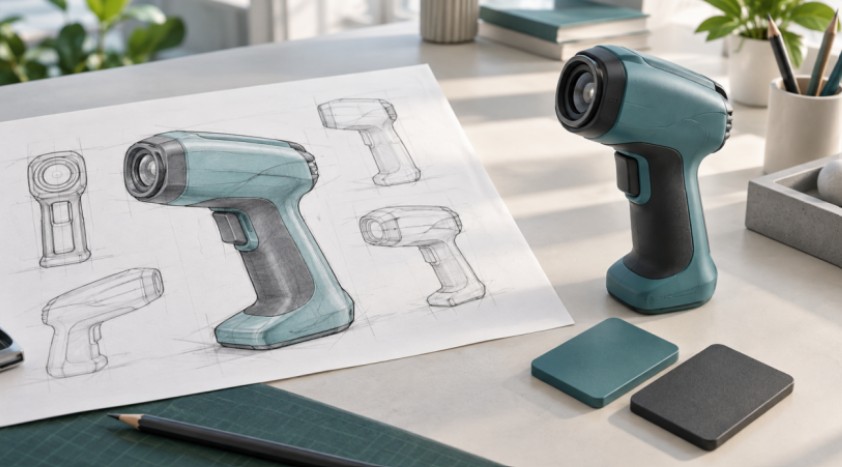
Consider a team exploring the outer housing of a handheld inspection device. A concept illustration shows a rounded head, a grip and a broad base. The immediate decision might be whether the head looks too large for the grip, or whether the base gives the product the intended visual balance.
Write that decision down before generating anything. Otherwise, a meeting can drift from the original shape question into a debate about colours, controls and features that nobody has specified. A short review brief keeps the discussion useful: compare the overall proportions, identify the preferred direction and list the details that need a designer’s attention.
Choose an appropriate level of confidence for each observation. Reviewers can discuss whether the grip appears narrow. They cannot establish comfort from a screen view alone. A physical handling study and measured design work would be needed to answer that question properly.
Prepare a reference that represents one design
Use a clear image of the selected concept, with the whole object visible. Separate it from competing sketches, presentation text and unrelated props. If the sheet contains several alternatives, crop the version the team actually wants to review.
A perspective view showing the front and one side often communicates more of the intended volume than a flat front view. Keep the reference internally consistent. Conflicting edges or a grip partly hidden behind another object leave more room for interpretation.
Keep the original image alongside the generated file. It provides a record of what the team supplied and helps distinguish a deliberate design decision from a shape introduced during generation. Name both files with the same concept identifier so they remain connected after the meeting.
Make the model useful in a supplier conversation
An early visual model can support a discussion about the intended external form. It helps the team point to a particular curve or compare the apparent depth of two alternatives. Suppliers can use that context when asking what information will be needed for the next stage.
Share a small set of consistent views rather than one flattering image. Show the front, side and rear, and include the original reference. A rear view inferred from a single picture should be identified as a proposal for discussion. It does not establish how an existing product is constructed internally.
Keep purchasing assumptions separate from the visual file. A concept mesh alone cannot establish a reliable manufacturing quotation. A supplier may need a dimensioned drawing, material grade, tolerances and expected quantities before pricing the work. Ask which inputs are missing and assign someone to provide them.
Separate appearance decisions from engineering decisions
Both kinds of decision matter, but they belong in different parts of the review. Recording them separately helps prevent a visually accepted concept from being mistaken for an approved production design.
Appearance and communication
Check the silhouette, the relationship between major volumes and the way the design reads from typical viewing angles. Record specific feedback such as widening the base or reducing the apparent depth of the head. Those comments give the designer a clearer next step than a general request to make the product look better.
Dimensions and construction
An engineer should define the dimensions and evaluate how the housing accommodates its components. Wall thickness, fasteners, assembly access and material behaviour require further design work. A rendered seam or opening does not prove that the corresponding assembly feature exists in the geometry.
Keep revisions traceable
Save the model used in the review before generating or editing another version. Give alternatives distinct names and keep a short note explaining why each was created. That prevents a later presentation from quietly replacing the version on which an earlier decision was based.
For the inspection device, one revision might explore a wider base while another changes the head profile. Compare those changes against the same views and neutral lighting. A dramatic material finish can distract reviewers from the proportion question they were asked to resolve.
At the end of the meeting, record which version was selected, who made the decision and which questions remain open. This record can be a short document attached to the files. It does not require a complex new system.
Judge the workflow by what happens next
Try the process on a limited concept review before making it a routine step. Record the time spent preparing the reference, reviewing results and preparing the handoff. Also note whether the model helped the team resolve a question that had remained unclear in the sketch.
Include the work that follows generation. If the team needs extensive corrections before anyone can discuss the design, those corrections belong in the evaluation. If a simple model supports a clear decision with little preparation, that is useful evidence for repeating the approach on similar projects.
The next handoff should contain the chosen concept, its source image and the unresolved engineering requirements. N4D can provide the visual starting point for that discussion. The team’s review record carries the decision forward into detailed design and supplier planning.
 Unisys Names Dwayne L. Allen as Chief Technology Officer & Senior Vice President, Solution Innovation & Architecture
 How SASE redefines enterprise security
 D-Link’s DGS-1210 Series Smart Managed Gigabit Switches Now Compatible with Nuclias Connect
 How a Common Contraceptive Injection Is Tied to Health Risks
 High-Growth Supply Chain Businesses Adopting AI & Machine Learning at Faster Pace than Competitors
 Joloda Hydraroll Enhances Anglesey Production Facility with Metal Plasma Cutting Machine