

The container cleared customs on a Tuesday.
By Friday, the stock was on the shelves and the margin report looked fantastic. Thirty two percent on a product line that usually makes twenty.
Then the month ended. The statement from the supplier arrived. And the numbers stopped agreeing with each other.
If you buy stock from overseas, or even across the country, you’ve probably lived some version of this. The supplier’s price is not what the goods actually cost you. Freight, insurance, duty, clearance and the last few miles to your warehouse all have to land somewhere. That somewhere is your landed cost.
Let’s follow it the way it happens in a small business, from purchase order to month end, with real numbers at every step.
Landed Cost, Defined
Landed cost is the total cost of getting a product into your warehouse and ready to sell. It is the supplier’s price plus inbound freight, insurance, import duty, clearance fees and handling, minus any trade discounts. Taxes you can reclaim, such as import VAT for a VAT registered business, stay out.
That is the short version. The landed cost meaning that matters for your margins is simpler still: it is the number your selling price has to beat.
It is not your overheads. Rent, salaries and shipping orders to customers sit elsewhere in your accounts.
This is not just a rule of thumb. IAS 2 Inventories, the international accounting standard for stock, includes in the cost of purchase the purchase price, import duties and taxes you cannot recover, and transport, handling and other directly attributable costs, less trade discounts.
At a Glance
What it is: The full cost of getting stock into your warehouse.
What goes in: Supplier price, inbound freight, insurance, duty, clearance, handling.
What stays out: Reclaimable taxes, outbound delivery to customers, general overheads.
Why it matters: It sets your real unit cost, your margin and your pricing.
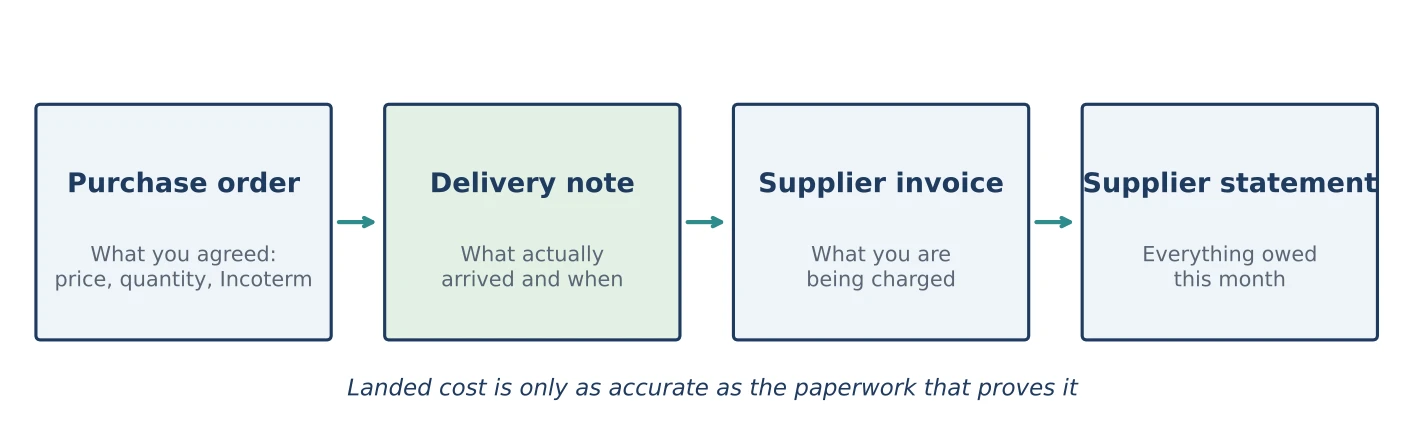
Where the proof lives: The purchase order, the delivery paperwork, every cost invoice and the month end statement.
What Goes Into Landed Cost
Think of the supplier’s price as a flight ticket. The real trip also includes the taxi, the checked bag and the seat you paid extra for.
| Cost line | Usually included? | Why |
|---|---|---|
| Supplier price, net of trade discounts | Yes | The starting point |
| Inbound shipping to your warehouse | Yes | A direct cost of acquiring the goods |
| Freight insurance on the shipment | Yes | Protects the goods on the way to you |
| Import duty | Yes | A tax you cannot get back |
| Customs clearance and handling fees | Yes | Needed to release the goods |
| Import VAT | No, if you are VAT registered | You reclaim it, so it is not a cost |
| Delivery to your customers | No | A selling cost, not a cost of buying |
One detail catches people out. HMRC guidance says the UK customs value includes transport and insurance up to the point the goods enter the UK. Delivery inside the UK isn’t part of the customs value, but it is still part of your cost.
So the duty is worked out on one number, and your real cost is built on a slightly bigger one.
Who Pays What: Incoterms and Your Costs
Before you add up a single invoice, look at the purchase order. The Incoterm on it, defined by the International Chamber of Commerce in Incoterms 2020, decides which costs are yours.
| Incoterm | Who pays the main freight and insurance | What you add to the supplier price |
|---|---|---|
| EXW (Ex Works) | You, from the supplier’s premises | Everything: collection, freight, insurance, duty, delivery |
| FOB (Free On Board) | You, once the goods are on the ship | Sea freight, insurance, duty, clearance, UK delivery |
| CIF (Cost, Insurance and Freight) | The supplier, to the destination port | Duty, clearance, UK delivery, and extra cover if you want more than the minimum |
| DDP (Delivered Duty Paid) | The supplier, all the way to you | Very little. It is already in the price |
Same product, same supplier, and the invoice price can mean four different things. A FOB price of £6 and a DDP price of £7 are not a £1 difference until you have done the maths.
Worked Examples
All three examples follow Northgate Fittings, a fictional distributor of plumbing fittings. The numbers are sample data, rounded to the penny.
Example 1: A Simple Domestic Order
Northgate buys 500 brass elbows at £10 each from a UK manufacturer. The supplier charges £250 delivery on a separate line. That £250 is inbound freight, a cost of getting the goods to you.
| 500 × £10 = £5,000. £5,000 + £250 = £5,250. £5,250 ÷ 500 = £10.50 per unit. |
So what? If Northgate prices these at a 40% markup on £10, it is really marking up £10.50, and every unit makes 50p less than the spreadsheet says.
Example 2: An Import on FOB Terms
Next, Northgate imports 2,000 valves at £6 each, FOB. Everything after the goods are on the ship is Northgate’s problem.
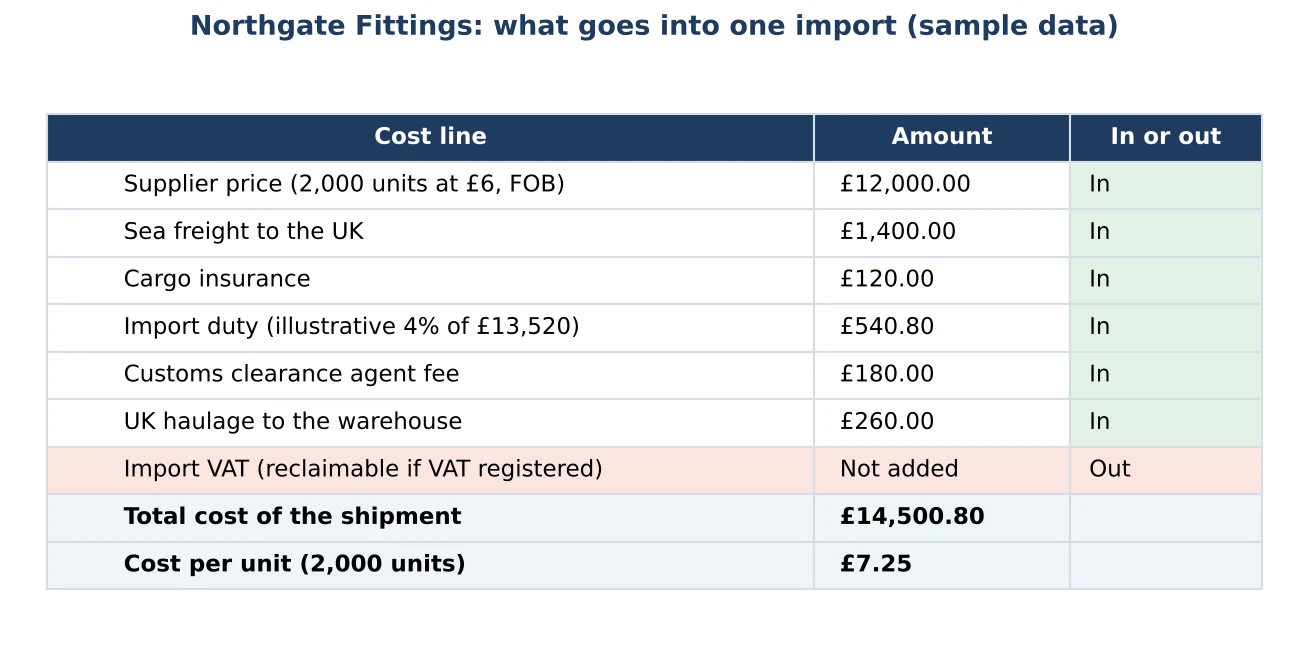
Customs value is goods plus sea freight plus insurance: £12,000 + £1,400 + £120 = £13,520. At an illustrative 4% duty rate, duty is £540.80. Add the £180 clearance fee and £260 of UK haulage: £14,500.80 in total.
Import VAT is left out, because Northgate is VAT registered and reclaims it.
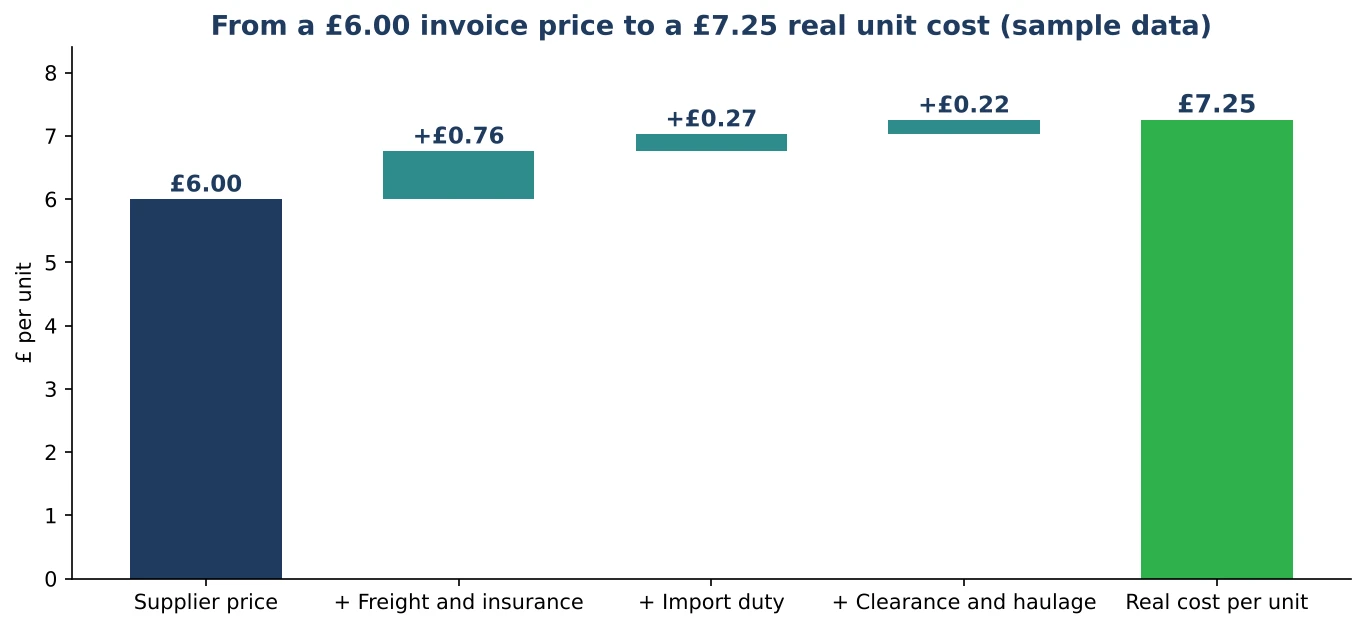
£14,500.80 ÷ 2,000 = £7.25 a unit. The invoice said £6. Every valve really costs about 21% more than the price you would quote from memory.
Example 3: When the Paperwork Disagrees
Same import, two small slips.
The forwarder’s freight and insurance invoice arrives two weeks late, so nobody adds it. And only 1,950 valves arrive, but nobody checks the paperwork, so the books assume 2,000.
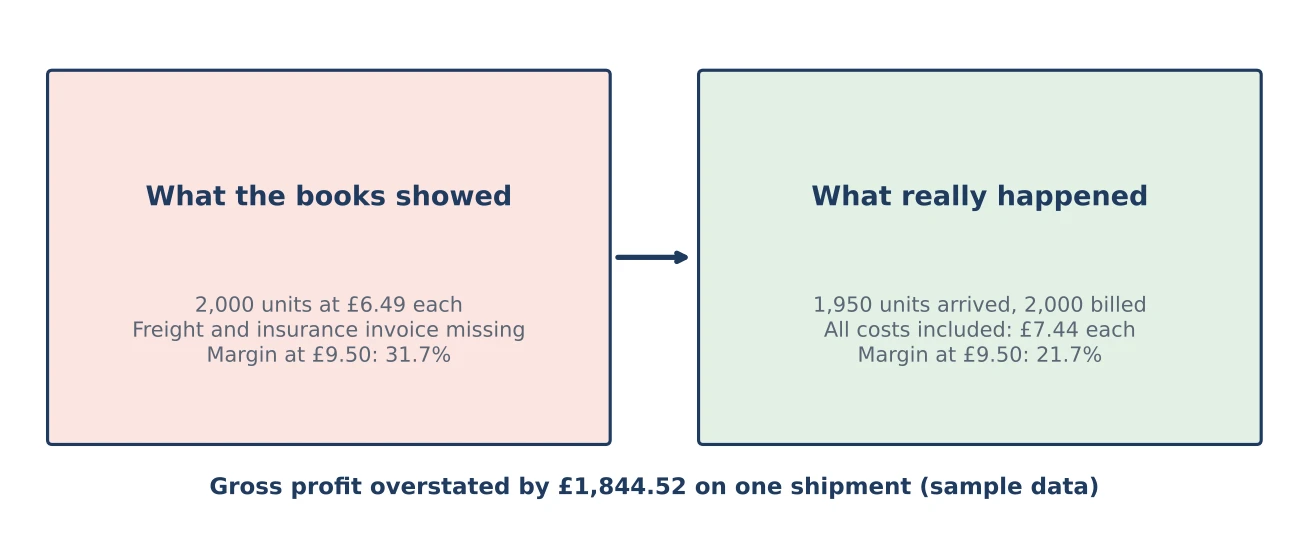
The books record £12,980.80 over 2,000 units: £6.49 each. Reality is £14,500.80 over 1,950 units: £7.44 each, until the supplier credits the missing 50.
At a £9.50 selling price, the margin looks like 31.7%. It is really 21.7%. On one shipment, gross profit is overstated by £1,844.52.
Nobody did anything dramatic. Two documents just never met.
How to Build the Number From Your Paperwork
Five steps, in the order the paper arrives.
1- Check the Delivery Note Against the Order
Why: the delivery note is your proof of delivery, the only record of what actually came through the door. Count it, sign it and compare it with the purchase order before anyone files it.
Tip: if you don’t have a standard format, use a delivery note you can print with every shipment so every delivery is checked against the same fields.
2- Collect Every Cost Invoice for the Shipment
Why: the supplier invoice is one of four or five bills. The forwarder, insurer, clearance agent and haulier invoice separately, often weeks apart.
Tip: give each shipment a reference and keep it open until every invoice for it is in.
3- Spread Shared Costs Across Products
Why: one container often carries different products. Say it carries 1,000 valves at £9 (£9,000) and 10,000 plastic clips at £0.30 (£3,000), with £2,500 of shared costs. Split by quantity, each item takes about 23p. The clips jump from 30p to almost 53p, a 76% rise. Split by value, the valves take £1,875 and the clips £625, so a clip costs about 36p.
Tip: value or weight is usually fairer than a headcount. Pick one method and stick to it.
4- Turn the Total Into a Real Unit Cost
Why: the total only becomes useful divided into the cost of each unit you can sell. That unit cost flows into your stock value, then into cost of sales when the items sell.
Tip: this cost of goods sold calculation sheet lets you enter each batch at its real unit cost and compare FIFO and weighted average side by side.
5- Reconcile the Supplier Statement at Month End
Why: the monthly statement lists every invoice, payment and credit. A short delivery or missing credit note shows up here, because the balance won’t match your records.
Tip: a monthly supplier statement template makes it easy to tick off each line against your own ledger before you pay.
Freight In vs Freight Out
| Freight in | Freight out | |
|---|---|---|
| What it is | Shipping the goods to you | Shipping the goods to your customer |
| Where it goes | Into the cost of your stock | Into selling and distribution costs |
| Affects unit cost? | Yes | No |
Freight coming in is part of what the goods cost you. Freight going out is part of what it costs to sell them.
Documents get mixed up the same way. Here is statement vs invoice, plus the paper that arrives before both.
| Document | What it proves | When you get it |
|---|---|---|
| Signed delivery paperwork | What physically arrived | With the goods |
| Supplier invoice | What one order costs | After dispatch |
| Monthly statement | Everything owed for the period | Usually monthly |
Common Mistakes
| ✗ Adding reclaimable import VAT to the cost
Why it matters: It inflates your unit cost and your prices. The fix: Include only duty and taxes you cannot get back. |
| ✗ Ignoring the Incoterm
Why it matters: You double count freight the supplier paid, or miss freight you owe. The fix: Read the Incoterm before adding anything up. |
| ✗ Spreading freight by quantity when values differ
Why it matters: Cheap, bulky items look expensive and expensive ones look cheap. The fix: Allocate by value or weight, consistently. |
| ✗ Filing delivery paperwork unchecked
Why it matters: You pay for goods you never received, and the unit cost stays wrong for months. The fix: Match every arrival to its purchase order before it is filed. |
How Enerpize Handles Landed Cost
What does this look like when the paperwork lives in one system instead of four folders?
Enerpize is a cloud-based, all-in-one ERP platform for small and medium-sized businesses, combining accounting, inventory, HR, sales, and CRM in a single system. It doesn’t make the judgment calls for you, like how to spread a shared freight bill, but it keeps the documents behind them together.
Purchase Orders and Received Quantities
Purchase orders go out from the purchases module and received quantities are confirmed against them, so a short delivery shows up on arrival, not at month end.
Supplier Invoices Captured by AI
Supplier invoices can be uploaded singly or in bulk, and AI pulls out the supplier, line items, amounts and taxes for review, so the late forwarder invoice is recorded the day it lands.
Average Cost and Supplier Reports
Inventory reports show stock value and product average cost, and supplier reports cover balances, purchase invoices and statements for the month end check.
Who Needs This
Distributors and Wholesalers
Bulk buyers on thin margins, where a few pence of missed freight is the whole profit on some lines.
Small Manufacturers
Raw material costs flow straight into your cost of goods manufactured. Get them wrong and every finished product inherits the error.
Online Sellers Who Import
Brands buying from overseas factories on FOB or EXW terms, where most of the shipping chain is theirs.
Key Takeaways
-
- A £6 FOB price became a £7.25 real unit cost once freight, insurance, duty and handling were added, about 21% more.
- IAS 2 counts only taxes you cannot recover, so reclaimable import VAT stays out.
- In the UK, customs value includes transport and insurance up to the point the goods enter the country.
- The Incoterm decides which costs are yours: almost all under EXW, almost none under DDP.
- Splitting £2,500 of freight by quantity raised a 30p clip to almost 53p. By value, it rose to about 36p.
- One missed freight invoice and one unchecked delivery overstated profit by £1,844.52 on a single shipment.
Frequently Asked Questions
What is landed cost?
It is the total cost of getting goods into your warehouse ready to sell: the supplier’s price plus inbound freight, insurance, import duty, clearance and handling, minus trade discounts. Taxes you can reclaim are left out. It is the true starting point for your unit cost and your pricing.
What is freight out?
Freight out is the cost of shipping goods from you to your customers. Unlike inbound freight, it is not part of the cost of your stock. It is usually treated as a selling or distribution cost in your accounts.
Is import VAT part of the cost of my stock?
Usually not, if your business is VAT registered and can reclaim it. Under IAS 2, only taxes you cannot recover belong in the cost of purchase. Import duty, which you cannot get back, does belong.
What is a delivery note?
It is the document that travels with a shipment and lists what was sent. Once you have counted and signed it, it becomes your proof of delivery, which is why it should be checked against the purchase order before the supplier’s invoice is approved.
Should inbound freight be added to the value of my stock?
Yes. Inbound freight is a cost of getting the goods to you, so it belongs in the cost of the stock and flows into cost of sales when the items sell. Freight to customers does not.
How do I spread shared freight across different products?
Choose a basis that reflects what drives the cost, usually value, weight or volume. Splitting by quantity alone can badly distort cheap, bulky items. Whichever method you choose, use it consistently.
Does the Incoterm change what my stock costs?
Yes. Under EXW or FOB, you pay most of the freight and insurance yourself, so you add them on. Under CIF the supplier pays freight and insurance to the destination port, and under DDP almost everything is already in the price.
How often should I reconcile supplier statements?
Monthly, when the statement arrives and before you pay it. Tick each invoice, credit and payment against your own records. It is the last chance to catch short deliveries and missing credit notes before they become permanent errors in your stock value.
Back to That Tuesday
The container still clears customs on a Tuesday. The stock still lands on the shelves by Friday.
What changes is the margin report. It now shows 21.7% instead of a flattering 31.7%, because every invoice for the shipment has been counted and every delivery has been checked.
Less exciting. Much more useful.
Landed cost is not a finance team luxury. It is the difference between knowing your margin and hoping for it.
Author Bio: Omar El Bahr, Senior Digital Growth Specialist, Enerpize.
Omar El Bahr is a Senior Digital Growth Specialist at Enerpize, where he leads SEO, content strategy, and organic growth across international markets. He is a Forbes Communications Council contributor and has written for Entrepreneur on business communication and digital strategy.
 Follow the Yellow Brick Road to S/4HANA
 Programming among the most desirable skills for future prospects, according to UK students
 Navigating the Polycrisis: Turning Supply Chain Challenges into Opportunities
 Data Privacy Week 2026: Why AI resilience & sovereignty is now a top priority for organizations
 How Your Website Is Letting Down Your Supply Chain Business
 How Can Manufacturing Companies Benefit from AI in 2022?