

In my experience working with manufacturing and supply chain teams, I’ve seen operations derailed by a single problem. It’s not a major disaster or a market crash. It’s something far more subtle and often overlooked: inaccurate bill of materials data.
A Bill of Materials, or BOM, seems straightforward. It’s a list. Just a list of parts, quantities, and specifications needed to build a product. How difficult can that be to
keep accurate?
Yet this “simple list” touches every department in an organization. Procurement uses it to order parts. Production uses it to plan assembly. Engineering uses it to design. Finance uses it to calculate costs. Inventory managers use it to stock materials. When that list contains errors, the ripple effects cascade across your entire supply chain.
The cost is staggering. Industry data suggests that BOM errors contribute to 20-30 percent of supply chain inefficiencies in manufacturing. Beyond the metrics, I’ve watched companies lose millions on expedited shipping, missed production windows, and obsolete inventory because their BOM data wasn’t reliable.
The Hidden Costs of BOM Inaccuracy
Let me walk through what inaccurate BOM data actually costs.
Procurement mistakes. When a BOM lists incorrect part numbers or outdated specifications, your procurement team orders the wrong components. You might order a resistor with the wrong tolerance. You might specify a connector that doesn’t fit. The part arrives, engineers discover the mismatch, and now you’re expediting a replacement or sourcing an alternative mid-production. That expedited order costs 2-3 times the normal price.
Production delays. Your assembly line is ready to build. Your team has scheduled the labor. Your customers are expecting delivery. Then halfway through production, you discover your BOM was missing a component entirely. Or it listed the wrong quantity. The line stops. You’re scrambling to find parts that weren’t planned for. Your production schedule collapses.
Excess and obsolete inventory. Inaccurate BOMs lead teams to overstock components they think they need. You might maintain high inventory of a part that’s actually only used in one discontinued product. Over time, those parts become obsolete. You’re carrying dead capital on your balance sheet. In industries like aerospace and automotive, where product lifecycles span decades, keeping accurate BOMs is the only way to avoid warehouses full of parts you’ll never use.
Cost overruns. When procurement doesn’t have accurate BOM data, they can’t negotiate effectively with suppliers. They can’t forecast demand. They can’t consolidate orders across products to get volume discounts. Instead, they’re making emergency purchases at premium prices. Your bill of materials should be the foundation for strategic supplier negotiations. Inaccurate data makes that impossible.
Quality and compliance issues. In regulated industries, your BOM is part of your compliance record. If your BOM doesn’t reflect what actually went into a product, you’ve got serious audit and certification problems. If a part fails in the field and you need to investigate, you need to know exactly which version of that part was in which batch. An inaccurate BOM means you can’t answer that question.
Let me give you a concrete scenario. A mid-sized electronics manufacturer discovers that their BOM for a control module lists a capacitor that was discontinued two years ago. The replacement part has slightly different specifications. The engineer who knew about the change left the company. The BOM was never updated. Now they’re building products with outdated component information. They don’t realize the issue until customers start reporting field failures. The recall costs exceed $2 million. The customer relationships suffer. All because a single line in the BOM wasn’t maintained.
This scenario plays out hundreds of times across manufacturing every year. Sometimes the impact is smaller. Sometimes it’s worse.
Why BOM Accuracy Breaks Down
If accurate BOMs are so critical, why do companies struggle to maintain them?
The traditional approach relies on spreadsheets, email updates, and manual data entry. When a part is discontinued, someone sends an email. When a design changes, an engineer updates one copy of a spreadsheet. When a supplier changes a part number, that information sits in someone’s inbox. Different teams end up with different versions of the same BOM. No one knows which version is current.
Engineering makes a design change on Tuesday. Manufacturing doesn’t see the update until Friday. Procurement ordered based on the old spec on Wednesday. Quality control is inspecting against the original BOM.
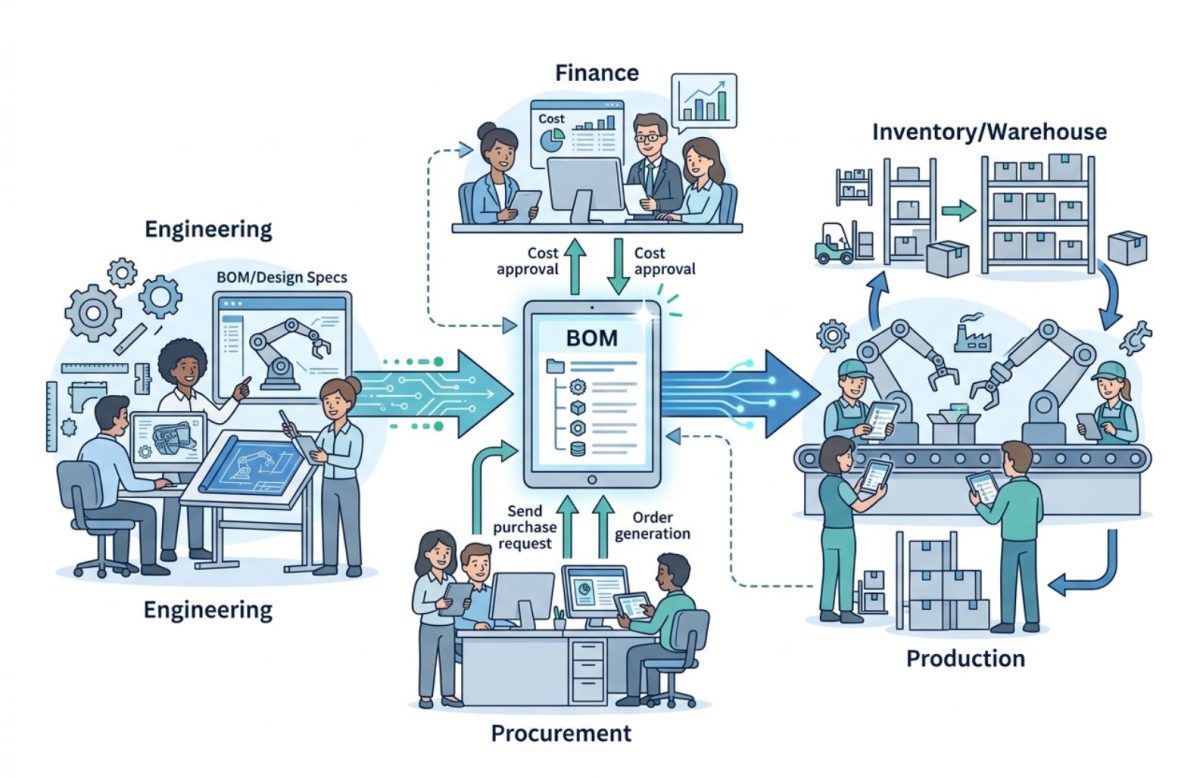
The larger your organization, the worst this problem becomes. With multiple product lines, multiple sites, and multiple suppliers, keeping everyone synchronized on BOM data becomes nearly impossible with manual processes.
And here’s the real problem: there’s no incentive structure to fix it. A small BOM error doesn’t create immediate drama. It might cause a problem three months later on some other production run. By then, no one remembers who should have updated the data. The cost is distributed. No single department feels the full impact. So it gets deprioritized.
How Forward-Thinking Organizations Are Solving This
The organizations achieving real supply chain efficiency have stopped treating the BOM as a spreadsheet document that lives in someone’s folder. They’ve recognized it as critical infrastructure. Their approach centers on five key principles.
Real-time updates across all systems. When a part is discontinued or a specification changes, that information needs to reach every team simultaneously. Not through email. Not through spreadsheets. Through a unified system that serves as the source of truth. When procurement initiates a supplier change, that update flows immediately to engineering, manufacturing, and quality. There’s no version confusion.
Controlled change management. Every change to a BOM needs visibility and approval. When an engineer needs to substitute a component, that change request goes through a formal process. Engineering reviews it. Manufacturing confirms it’s feasible. Procurement validates supplier availability. Then the BOM is updated for everyone. This prevents well-intentioned changes from creating unexpected downstream problems.
Collaboration across departments. The most effective systems break down silos. Engineers, procurement specialists, manufacturing planners, and quality teams can all see the same data. They can see the rationale behind a design decision. They can collaborate on solutions when issues arise. This cross-team visibility prevents the information gaps that create errors.
Integration with supplier data. Your BOM should connect to supplier databases. When a supplier discontinues a part or updates specifications, that information should automatically surface in your system. You shouldn’t discover a supplier change through a production delay. A proper bill of materials management system enables this kind of integration, so your teams stay aligned with real-world supplier realities.
Complete history and traceability. Every change to your BOM should be timestamped and attributed. Who changed what? When? Why? This history is essential for understanding your product and troubleshooting quality issues. It’s also critical for compliance and audits.
Organizations implementing these practices report significant improvements. Procurement lead times shrink. Production planning becomes more reliable. Quality issues drop because you know exactly what went into each product. And perhaps most importantly, teams trust their BOM data. They can make decisions with confidence.
Understanding the Right BOM Structure for Your Operations
Many companies struggle with BOM accuracy not because they’re careless, but because they’re using a single BOM structure for multiple purposes. Engineering needs one view. Manufacturing needs another. Procurement has yet another set of requirements.
The key insight is understanding what you actually need. Different BOM formats serve different purposes. Your engineering BOM captures design intent. Your manufacturing BOM reflects what you actually build, including assembly instructions. Your procurement BOM optimizes for supplier orders and lead times. A practical guide to different BOM types shows you how companies distinguish between engineering BOMs, manufacturing BOMs, service BOMs, and configurable BOMs based on their actual operational needs.
When you’ve got the right BOM structure supporting your specific operations, keeping it accurate becomes far easier. Everyone’s using the format that actually helps them. Buy-in improves. Maintenance becomes a normal part of the workflow instead of a painful chore.
The Cost of BOM Errors: Impact by Department
| Department | Impact of BOM Inaccuracy | Typical Cost |
| Procurement | Wrong parts ordered, expedited shipping | 2-3x premium on replacement orders |
| Production | Line stoppages, schedule disruption | $5,000-50,000 per hour of downtime |
| Inventory | Excess stock, obsolete parts | 15-25% of inventory value wasted |
| Quality | Non-conformances, field failures | $50,000-2M+ per recall event |
| Finance | Inaccurate costing, margin erosion | 3-5% margin loss on affected products |
| Compliance | Failed audits, certification delays | Weeks of remediation, potential fines |
Building a Sustainable BOM Accuracy Program
This isn’t a one-time fix. BOM accuracy requires ongoing commitment.
Start by auditing your current state. Do you know whether your BOMs are accurate? Have you validated them against actual production? Compare your BOM data against what your production team actually builds. Find discrepancies. Understand where your data is breaking down.
Define ownership. Someone in your organization needs to own BOM accuracy. This isn’t necessarily a full-time role for a small company, but it needs to be someone’s responsibility.
Establish change processes. Create a formal procedure for any BOM change. Who can request changes? Who reviews them? Who approves them? Who updates all affected systems? A clear process prevents informal changes that create confusion.
Train your teams. Your procurement team needs to understand how BOM changes affect their lead times. Your quality team needs to understand how to use BOM history for traceability. Your engineers need discipline around updating BOMs when they make design changes. Accuracy requires cultural commitment.
Measure what matters. Track BOM-related issues. How many production delays were caused by inaccurate BOMs? How many expedited supplier orders? How much excess inventory exists due to BOM errors? Visible metrics drive behavior change.
The Strategic Impact
When you get BOM accuracy right, you’re not just preventing problems. You’re enabling better decision-making across your entire supply chain.
Accurate BOMs let you forecast demand reliably. They let you negotiate strategically with suppliers. They let you optimize production schedules. They let you manage risk proactively instead of reactively.
Most importantly, they give your organization confidence. When your teams trust their BOM data, they can focus on actual supply chain optimization instead of constantly verifying whether the data is reliable.
The foundation of supply chain efficiency isn’t sophisticated analytics or complex optimization algorithms. It’s accurate master data. It’s the bill of materials. Get that right, and everything else becomes possible.
Frequently Asked Questions
What are the most common BOM errors in manufacturing?
The most common errors fall into several categories: incorrect part numbers or revisions, missing components, outdated specifications, wrong quantities, and design changes that weren’t reflected in the BOM. These often stem from manual data entry, lack of change control, or communication breakdowns between engineering and manufacturing. The key is implementing a system that prevents errors at the source rather than trying to catch them after production starts.
How does BOM accuracy affect supply chain costs?
Inaccurate BOMs create costs throughout your supply chain. You experience expedited freight charges when parts don’t match. You incur excess inventory holding costs from overstocking based on faulty data. You lose supplier volume discounts because you can’t consolidate orders accurately. You pay for quality investigations and recalls when products are built with wrong components. Companies often find that improving BOM accuracy delivers ROI within the first year through reduced expediting, inventory optimization, and fewer quality issues.
What is the difference between an engineering BOM and a manufacturing BOM?
An engineering BOM reflects the design as conceived. It includes all specifications and materials needed to build the product to design intent. A manufacturing BOM includes everything in the engineering BOM but adds manufacturing details: assembly sequences, tooling requirements, packaging specifications, and alternative approved parts that manufacturing can use. The manufacturing BOM is what actually guides production. Many companies maintain both because each serves a different critical purpose.
How can companies improve BOM data quality?
Start with an audit to understand your current state. Then implement a centralized system with proper change controls and version history. Define clear ownership and get buy-in from engineering, manufacturing, and procurement. Establish a formal change process so updates reach all teams simultaneously. Train your people on the importance of BOM accuracy. Finally, measure your performance: track BOM-related production delays, expedited orders, and excess inventory so you can see the impact of your improvements.
Why are spreadsheets insufficient for BOM management at scale?
Spreadsheets have critical limitations for BOM management. They don’t prevent version confusion when multiple copies exist. They don’t timestamp changes or show who made each edit. They don’t enforce change control or approval workflows. They can’t integrate with supplier systems or CAD tools. They don’t maintain complete audit trails for compliance. As your organization grows beyond a single product line or site, spreadsheets become a liability rather than a tool.
About the Author
The author is a supply chain operations leader with expertise in manufacturing systems, BOM management, and operational efficiency. He works with companies to build reliable data infrastructure that serves as the foundation for strategic supply chain decisions.
 Sage appoints new Chief Product Officer and Chief Strategy Officer
 Ivalua Partners With C2FO to Complete the Strategic Payments Journey & Enhance Access to Capital
 How Does a Vehicle Tracker Work?
 Pallet distributor moves to another compliance level with TruTac
 Pennine Acute Hospitals NHS Trust embraces new IBM FlashSystem technologies from Covenco
 Ransomware in 2023 – the threat businesses face & the controls they need to use