

Fleet inspection has increased a lot more in the past two years than in the last two decades. The change from clipboards and handwritten forms to guided photo capture and AI analysis isn’t just a technology growth. It’s a huge change in what inspection data can tell a fleet manager and how fast it becomes actionable. As the digital vehicle inspection market grows toward $3.22 billion by 2030, according to Research and Markets, the problem between fleets running image-based processes and those still depending on manual walkarounds is becoming a practical operational divide rather than a matter of preference.
The industries feeling this most impactfully are the ones where vehicle and the price of a missed flaw is most seen: commercial fleet operators, rental companies, leasing providers, and last-mile logistics businesses. For these processes, inspection is not just an administrative thing that has to be done. It’s the point where asset condition becomes documented, and the quality of that documentation helps to decide what gets caught, what does not get caught or is missed, and who takes the cost when something goes wrong after this inspection.
The Limits of the Traditional Walkaround
Manual fleet inspection was built around a simple thing: a trained person walks around a vehicle, notes what they see, and is done with the work. That process works when it’s done very carefully, under good conditions, by someone with proper time and attention to be thorough. In practice, those conditions rarely hold consistently across an entire fleet.
Inconsistency between inspectors increases the problem further. Two drivers completing the same check on the same vehicle make reports shaped by different thresholds, different attention levels, and different time limitations. That change of the result and judgment makes it impossible to compare condition trends for the vehicles, across sites, or across time in any reliable way. The inspection record becomes a compliance archive instead of a source of operational intelligence and it makes it much more difficult.
What Image-Based Inspection Actually Changes
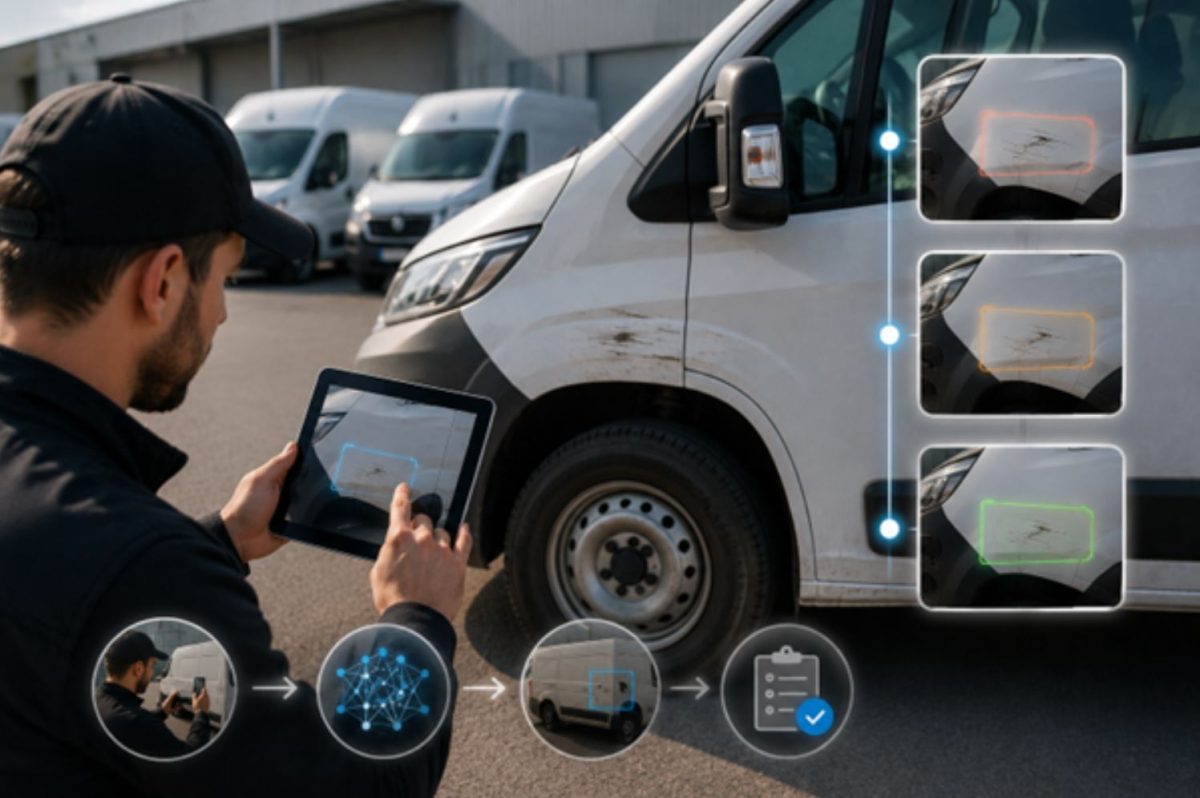
Guided photo capture combined with computer vision studies looks at these problems directly. Rather than depending on an individual’s visual assessment at a single point in time, the process takes in structured imagery that a trained AI model studies consistently and comparably across every inspection of the vehicle.
The results back this up. Fleets adopting fleet inspection automation report catching 40 percent more problems and defects than manual processes and completing inspections 67 percent faster. AI systems achieve 95 to 99 percent defect detection accuracy compared to manual review, with the gap most pronounced in high-volume, high-turnover environments where inspector fatigue and time pressure are constant.
A manual process that takes 30 to 45 minutes becomes a guided photo session completed in 5 to 8 minutes, according to fleet technology analysis from HVI. At a vehicle inspection where there is processing of dozens of vehicles every day, that time difference is directly related to faster vehicle availability and fewer morning time delays that happen. During peak return periods, when manual inspection creates a long wait time, AI-powered photo capture processes vehicles at a faster pace than in-person inspection physically cannot reach.

The Consistency Advantage at Scale
Speed and accuracy improvements are very important, but consistency is what makes image-based inspection actually scalable for multi-site fleet operations and processes. When the same AI model studies every photo submitted from every location and angle, the resulting data is comparable in ways that reports produced by different people at different depots simply cannot be matched.
That comparability helps with visibility that fleet managers with manual inspection programmes currently cannot give.Which depot consistently returns vehicles in better condition? Which vehicle types are getting wear issues earlier than others? Which routes relate with higher damage frequency? These are questions that need consistent, structured and practical data to answer. Manual inspection records, however diligently completed, rarely are able to give it.
As condition data gathers across a fleet, patterns come up that weren’t noticeable from individual inspection processes. Brake wear curves that conclude and predict when specific vehicle models typically need more attention than others. Body damage frequency by depot that shows operational practices. Driver behaviour patterns that go hand in hand with maintenance costs. These insights turn fleet inspection from a reactive compliance activity into a forward-looking operational tool, and they need the structured, comparable, longitudinal data that image-based inspection creates.
Where Vehicle Inspection Solutions Fit in the Broader Fleet Stack
Image-based inspection makes value on its own, but it grows when connected to the systems a fleet already uses for things like maintenance scheduling, driver management, and cost reporting. A vehicle inspection solution that gives condition data in a standalone application solves the detection problem without solving the workflow issue that has occurred. The data needs to reach the maintenance planner, the fleet manager, and the finance team in a format they can solve and act on without manual re-entry.
Platforms built and used for integration connect inspection results through APIs to fleet management software, maintenance scheduling tools, and reporting dashboards. Condition flags from an AI inspection trigger a maintenance work order automatically instead of just waiting for someone to study and analyse a report and decide whether to act. That closed-loop process is where the operational efficiency benefits from image-based inspection fully materialise, decreasing the time between a defect occurring in an inspection record and a vehicle returning to full service.
Inspektlabs provides this kind of connected vehicle inspection solution, combining AI-powered damage detection with condition tracking and API integration for fleet operators across insurance, leasing, and commercial transport. The platform surfaces condition data in the format downstream systems need rather than producing reports that require manual handling before they influence any operational decision.
The move toward fleet inspection automation is also being driven by compliance requirements that paper-based processes can no longer meet. FMCSA’s final rule published in February 2026, effective March 2026, explicitly allows electronic DVIRs under 49 CFR 396.11 and 396.13, giving digital inspection records full legal clearance and removing the last regulatory doubt that had led some operators to maintain paper processes along with the digital ones.

Adoption Is Moving Faster Than Most Expect
Only 32 percent of fleets have partially implemented AI inspection so far, but 65 percent of maintenance teams plan to adopt it by the end of 2026, according to FleetRabbit’s fleet digitisation research. That rate of planned adoption suggests the technology is moving from early-adopter status to mainstream expectation within a short timeframe, and the operational gap between fleets that have made the transition and those still running paper-based processes is widening with it.
For fleet managers studying where to direct technology investment, image-based inspection offers a clear combination of near-term efficiency gains and longer-term data capability that manual inspection cannot give, even after how carefully the process is carried out. The fleets helping to achieve consistent, AI-supported inspection workflows now are building a data foundation that will inform maintenance planning, driver management, and asset decisions for years ahead. The question for operations still running manual processes isn’t whether the shift is coming. It’s how much of that advantage they can afford to cede before making the move.
 Indigo enhances C-Suite with 3 key appointments
 Common Mistakes to Avoid When You Open a Demat Account
 Nynas Streamlines Complex Communications with Descartes’ Transportation Management Solution
 How Invoice Templates Drive Supply Chain Automation
 BCN3D announces new partnership with B2N
 Curve IT’s MDU Connect to provide network control to those running multi-dwelling units