

A unique hairstyle can be achieved by picking out particular parts of the hairstyle and not copying an overall hairstyle in a picture.
Testing proportions against your personal attributes, and articulating any structural changes clearly, you can develop a cut that belongs entirely to you.
Isolating Shapes From Moving References
Most people find ideas for haircuts by saving static images and often, that’s where their expectations are fooled. One image, styling products, studio light and the angle of the camera will do most of the work. When you are walking, or turn your head or step into the wind, that geometry falls apart if the underlying architecture isn’t appropriate for your natural hair behavior.
A better way is to examine the movement of hair in moving images. If you recall that a certain character or public figure’s fringe, neckline or volume caught your attention, you can find out specific moments when the hair moves freely under natural lighting by running a clip through a video scene search tool. You can observe the position of the weight line when they tip their head and the nearness of the bulk to the ears.
What is not being sought here is to duplicate the actor or the athlete. Instead, you accentuate micro-components like a blunt perimeter, tapered temple or textured weight through the crown. When you reduce a haircut to variables, you’re no longer copying someone else but rather you’re gathering modular parts.
Testing Proportions Before Cutting
When cutting, there’s always a bit of guesswork, particularly when it comes to tighter cuts. Many clients visit salons and request a certain cut they’ve seen on another person who has a different bone structure from them and leave the salon disappointed with the way their head looks after the cut.
Using a Short haircut visualization tool prior to significant shears work can help avoid a major mismatch. Digital modeling makes it possible to manipulate crown height, side density and fringe position on a scan or front facing image of your own skull. You’ll know if your jawline is exposed and complements your neck length, or if removing the temples makes your forehead look too wide.
The virtual preview should never be a stylist’s set template. Instead, use them as a border to see where your hair needs bulking up and where it needs thinning. Understanding your structure (which proportions do not work for you) prevents you from borrowing proportions that do not work for your structure.
Calibrating Texture and Daily Maintenance
A haircut doesn’t just come in a vacuum, or in isolation, from your daily routine, hairline density or facial hair. A style may look great on someone who takes 20 minutes each morning to blow dry and apply matte clay, but if you can’t get ready in more than 3 minutes, you’re in trouble.
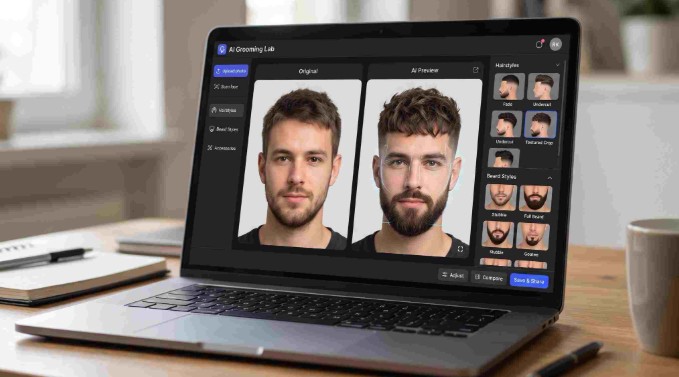
Considering the different hair densities and how they interact with facial growth or receding hairlines, an AI grooming visualization tool can be helpful to see how different textures look with beards, stubble, or clean shaven jawlines. It provides objective visual feedback of weight distribution. For example, a heavy texture on top with a full beard can look out of balance on a shorter face, while tight sides with the same beard style will provide clean balance.
The real filter for originality is your own lifestyle. Copying the style means fighting natural hair growth patterns if you are constantly having to heat style the hair to maintain the look, but your hair grows forward with two strong cowlicks. However, silhouette alterations to the natural grain yield a natural, rather than borrowed, look.
Formulating Concepts With Precise Descriptions
If you’re trying to come up with a new style, using general terms of fashion can create a misunderstanding. Defining the word edgy, modern or clean is all over the place. When it comes to hybrid cuts, you need to be exact in the language you use if you are looking for a specific cut that is a combination of two styles, for example, a soft mid-century taper combined with a modern texturizing through the crown.
A Prompt library online on the Internet allows you to browse a list of descriptive design vocabulary used by professional barbers and by digital stylists to define parameters. You learn technical terms such as weight lines, graduation angles, directional shearing, undercut drop depths and internal thinning.
Clear descriptions will enable you to create a precise mental blueprint. You don’t just say you want something relaxed but professional, you learn to explain what the relationship is between side length, crown volume and perimeter finishing. Precision also allows you to mix different influences together without going astray into caricature.
Partnering With Your Stylist
The last step in developing a new hairstyle is done in the salon or barbershop chair. Twelve photos of different celebrities can only irritate a stylist and three reference photos that show particular things can help to give a stylist direction.
Be specific when you tell your cutter what you like about each aspect; the softness of the perimeter in one image, the weight distribution of the second image, the density of the texture of the third image. After that, seek their technical comments. Inquire about how they will change the direction of your hair growth, any cowlicks and density.
A good stylist values the freedom to interpret shapes around your physical growth patterns rather than tracing a rigid photograph. They can adjust angle graduation by a few millimeters to flatter your occipital bone or adjust the thinning shears to account for fine hair strands. That collaborative adjustment is where an off the shelf trend transforms into a personal signature.
 National evaluation helps to create a blueprint for cloud-based healthcare e-rostering
 AEB invites to free Brexit Tool Kit Conference
 MICROLISE RECEIVES 2019 QUEEN’S AWARD FOR ENTERPRISE: INNOVATION
 Johnson Haulage bolsters fleet with low-loading Krone quartet
 Artificial intelligence for business: a year in review
 Matillion Accelerates Enterprise Data Integration with Matillion Data Loader 2.0